Two Years Later: Acknowledging Helene-Related Trauma & Continued Healing Across WNC

Two Years Later: Acknowledging Helene-Related Trauma & Continued Healing Across WNC

It’s hard to believe that two years have passed since Hurricane Helene changed Western North Carolina forever.

As September and October approach, communities across our mountain region find themselves reflecting on a date that now exists as a dividing line in memory: life before Helene, and life after.

For many residents, Helene was more than a storm. It was a moment of profound loss, uncertainty, and disruption. Homes were damaged or destroyed. Families were displaced. Beloved landscapes were altered. Lives, routines, and plans changed in ways that no one could have anticipated.

And yet, alongside the grief and devastation, Helene revealed something equally profound: the extraordinary strength, compassion, and resilience of Appalachian communities.

As we mark two years since Helene, we pause to remember what was lost, honor what has been rebuilt, and acknowledge the healing that is still unfolding.

“There’s lots of loss, lots of grief, lots of extreme stress, but also, so many stories of connection and love and neighbors helping neighbors and people coming to each other’s aid, and figuring it out together.”

Executive Director, Ann DuPre Rogers (Jan 2025)


Reflecting on the Last 24 Months

The aftermath of Helene brought challenges that many communities are still navigating today.

The storm left behind damaged infrastructure, interrupted livelihoods, environmental impacts, and deep emotional wounds. Recovery has required patience, persistence, and tremendous collective effort.

Across Western North Carolina, neighbors showed up for one another in countless ways—clearing debris, sharing supplies, repairing homes, offering childcare, and providing emotional support. These acts of care became more than moments of kindness; they formed the foundation of our region’s recovery.

Today, many signs of progress are visible. Roads have reopened. Homes have been repaired. Businesses have returned. Communities continue to adapt and rebuild.

Yet significant challenges remain.

Funding gaps continue to affect many rural areas throughout the 25 Helene-impacted counties. Environmental restoration efforts are ongoing. The economic impacts of the storm continue to unfold, and many families are still working toward stability and recovery.

Our work continues. And so does our HOPE!

Understanding the Lasting Impact of Trauma

While physical recovery is easier to see, emotional recovery often takes much longer.

One way to think about trauma is as experiencing “too much, too fast.”

In the case of Helene, few people could have anticipated the magnitude of what was coming. During a crisis, many of us instinctively enter survival mode. We compartmentalize emotions in order to make it through the immediate challenges before us.

That response can be incredibly effective in the short term.

But over time, emotions that are pushed aside can remain with us. Experiences and feelings may become stored in our bodies and nervous systems, sometimes resurfacing months—or even years—later.

The familiar fight, flight, or freeze responses that help us survive disasters can begin to affect our well-being when they persist for too long. The impacts may show up as anxiety, depression, exhaustion, headaches, sleep disruptions, high blood pressure, emotional distress, or a combination of physical and emotional symptoms.

Another common experience is survivor’s guilt, or what some describe as survivor’s grief. These feelings often arise from our deep capacity for connection and care. We carry one another’s stories, worry about our neighbors, and feel others’ pain alongside our own.

For many people across Western North Carolina, the anniversary of Helene may reactivate these emotional experiences.

That is completely normal. Trauma anniversaries can affect us in ways we do not always expect.

“I’ll never forget the Helene gratitude. I can let go of the grief, but the gratitude I hope that I’ll never forget. Every day is about experiencing more of the grateful part.”

Nicole K., WNC Resident

There Is No Right Way to Feel

The emotional aftermath of Helene continues to be deeply felt throughout our region.

Recovery is not only about rebuilding structures. It is about healing hearts, relationships, and communities.

Anniversary dates of traumatic events can stir powerful emotions. Some people may experience increased stress, anxiety, sadness, or irritability. Others may feel numb or disconnected. Some may find themselves avoiding reminders of the storm altogether.

All of these responses are valid. Each person’s healing journey is unique, and there is no single “right” way to navigate this milestone.

You may experience:

  • Overwhelm
  • Grief and sadness
  • Numbness
  • Avoidance
  • Shock
  • Reflection
  • Gratitude
  • A mixture of many emotions at once

Each person carries their experience differently.

As we move through the healing process, there will be days when sadness feels close to the surface. There may be moments of anger, fear, tenderness, or exhaustion. And there may also be moments of joy, gratitude, and connection.

Both can be true. We can honor loss while still recognizing growth, and we can remember what happened while still appreciating how far we’ve come.

The Grief, and the Gratitude

Two years later, we continue to be inspired by the countless people who helped carry our communities through the hardest days:

  • The first responders who answered urgent calls.
  • The healthcare workers who cared for those in need.
  • The educators who supported children amidst uncertainty.
  • The utility crews, public servants, nonprofit leaders, behavioral health providers, faith communities, volunteers, and neighbors who showed up day after day.

THANK YOU to these heroes and helpers whose compassion, courage, and commitment helped light the way forward. Your legacy of service and the countless stories of neighbors helping neighbors continue to define our region today.


Finding Ways to Remember & Heal

Many people benefit from creating intentional space around meaningful anniversaries.

That may look like:

  • Cooking or baking a favorite meal
  • Volunteering in your community
  • Attending a local commemorative event
  • Spending time in nature
  • Practicing meditation or reflection
  • Participating in a support group
  • Attending an educational workshop or training
  • Connecting with family, friends, or neighbors
  • Participating in a healing retreat
  • Creating new rituals and traditions of remembrance

There is room for every person in Western North Carolina to grieve, process, connect, and heal in ways that feel meaningful to them. As we approach Helene’s second anniversary, may you find ways to honor this time that feel authentic and supportive for you.

Resources for Resilience remains committed to supporting communities as they navigate the ongoing impacts of disaster, stress, and trauma. We are proud to offer community-centered programming designed to provide connection, practical tools, research-backed resources, and opportunities for reflection and healing.

While our programming is not a replacement for professional mental health treatment, they are especially helpful for those serving on the frontlines of community well-being, including first responders, behavioral health professionals, educators, public officials and civil servants, healthcare workers, community volunteers, and any other professionals dedicated to keeping our communities safe, informed, healthy, and connected.

2026 Helene-Anniversary Programming

Resources For Resilience continues to hold space for the many emotions WNC residents may be experiencing by offering judgement-free, trauma-informed opportunities to learn, reset, and reflect together in a community setting.

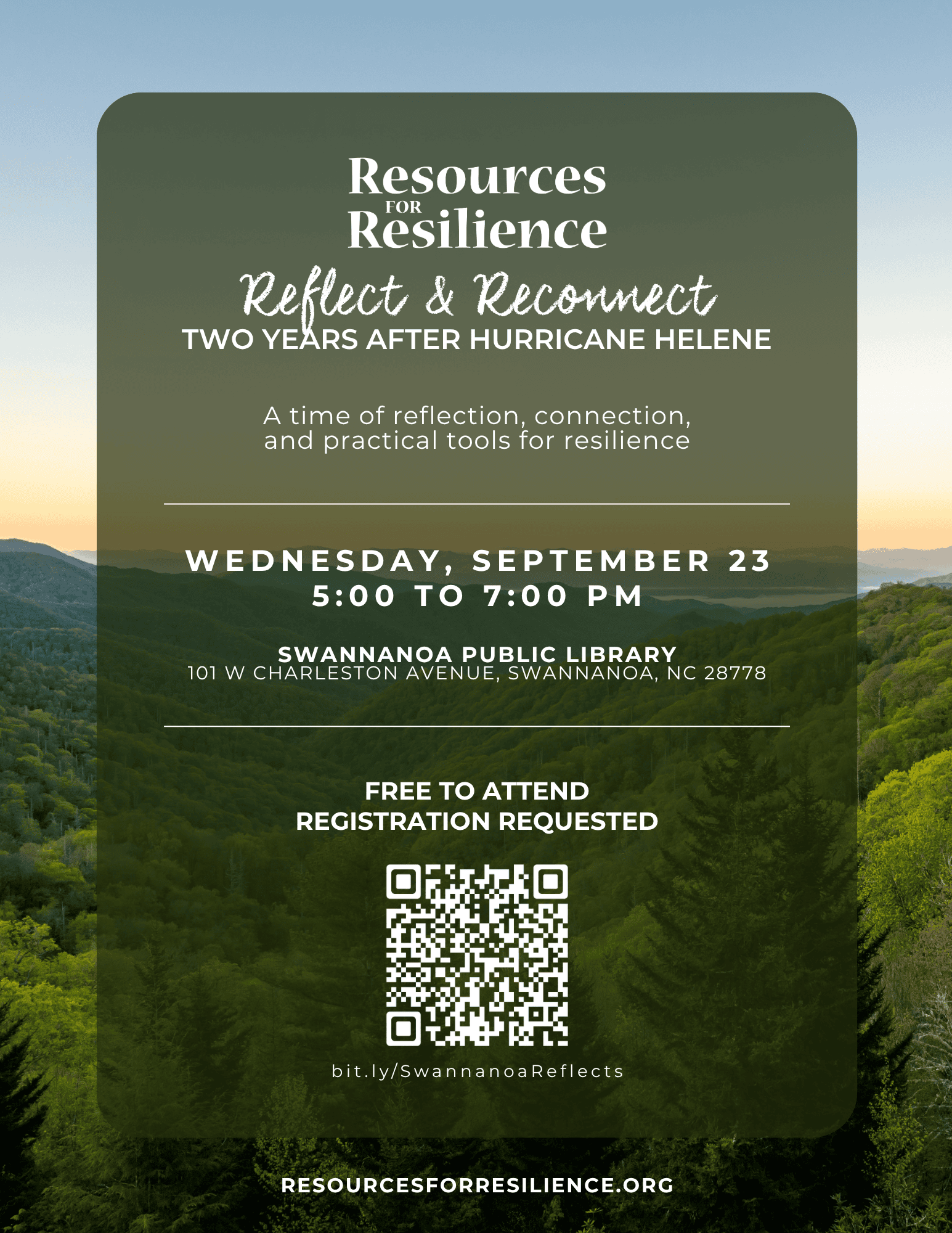
These FREE two-hour ‘Reflect & Reconnect’ sessions blend our ‘Reconnecting Through Hard Times’ curriculum with our Community Listening Circles to create a powerful experience that can help foster understanding, hope and nervous system regulation as participants navigate the varying healing and recovery journeys and complex emotions surrounding the storm.


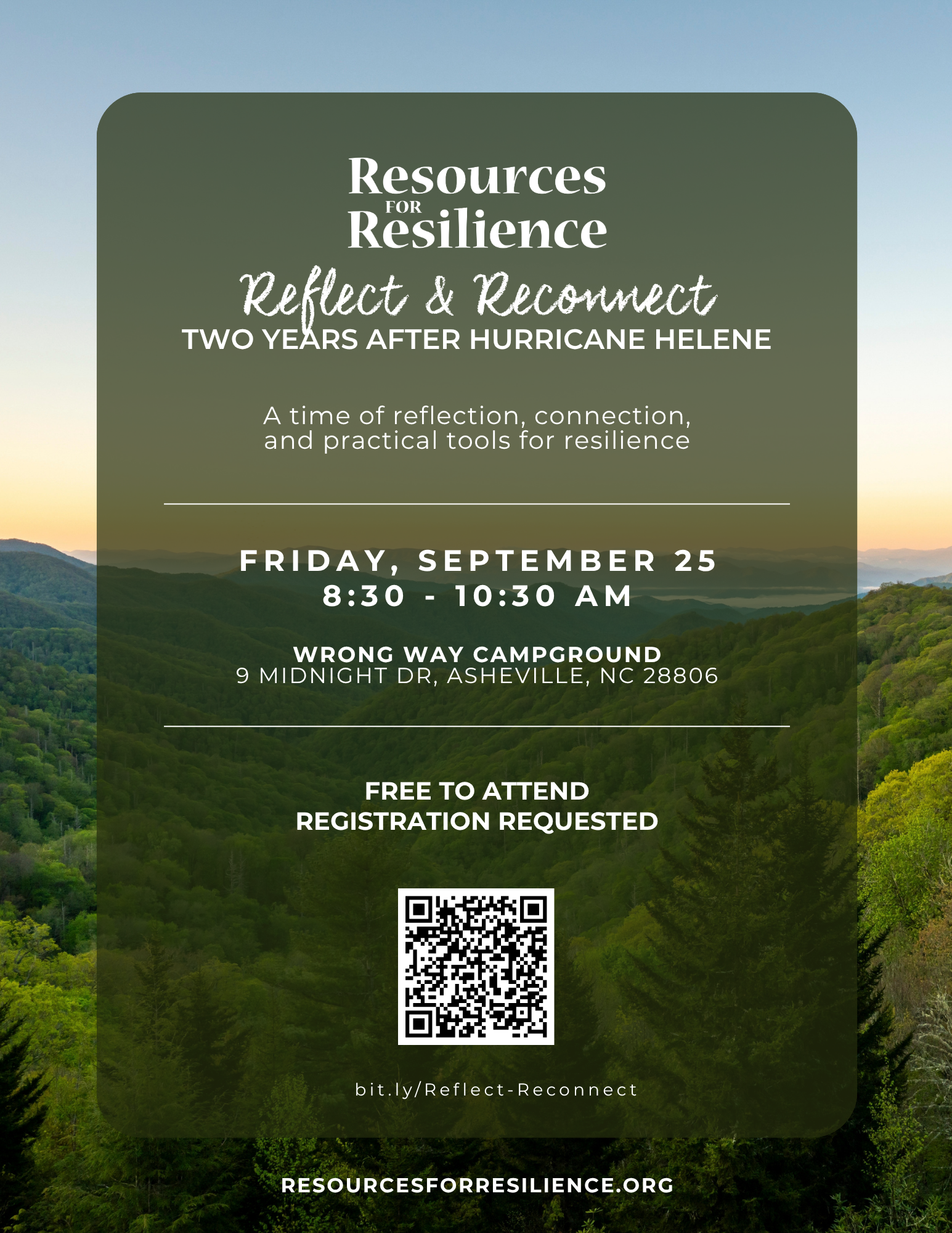
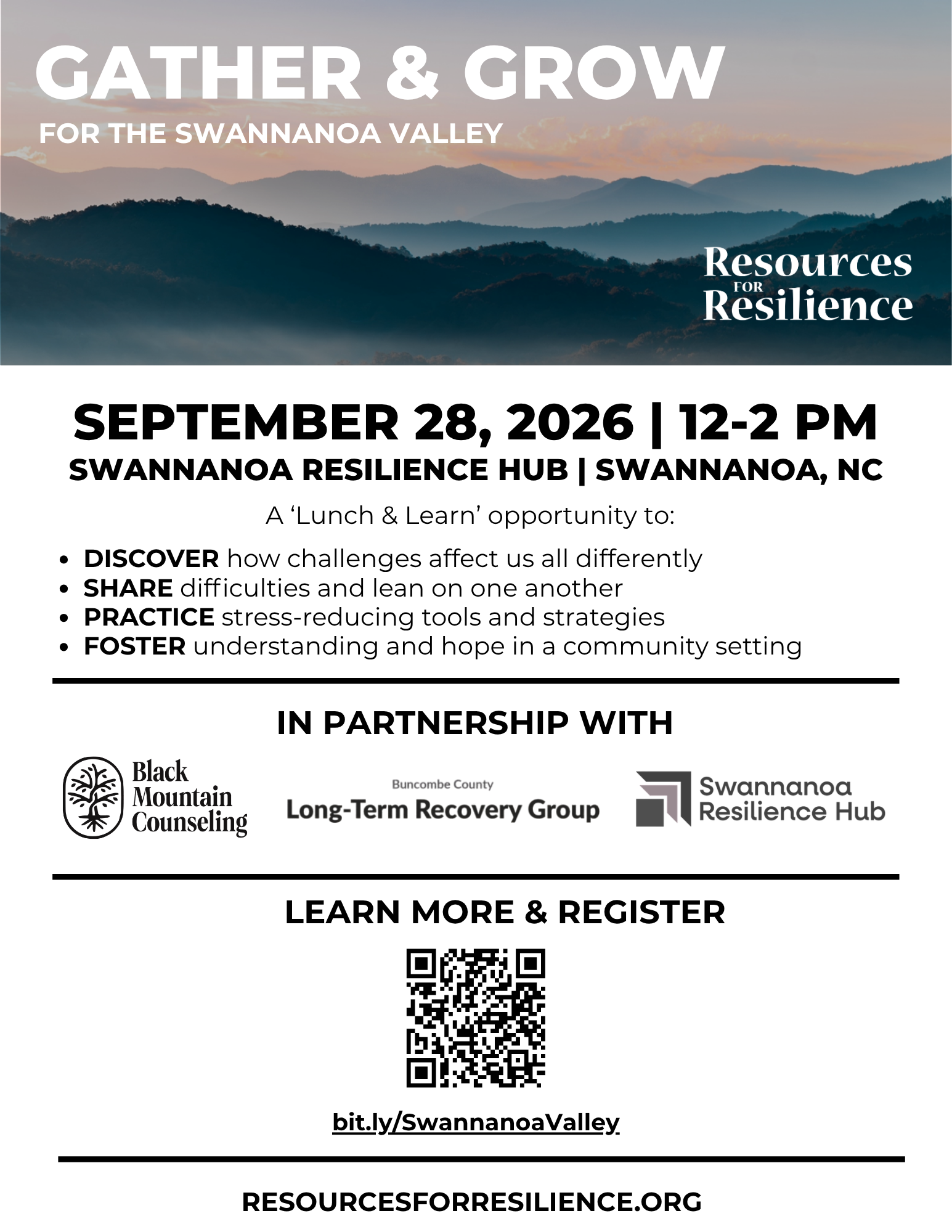
September 23, 2026 | 5-7 pm | Swannanoa Public Library

Along the banks of the Swannanoa River, the town of Swannanoa was one of the hardest-hit areas in Western NC, experiencing catastrophic flooding that destroyed countless homes, businesses, bridges, and infrastructure.

September 25, 2026 | 8:30-10:30 am | Wrong Way Campground

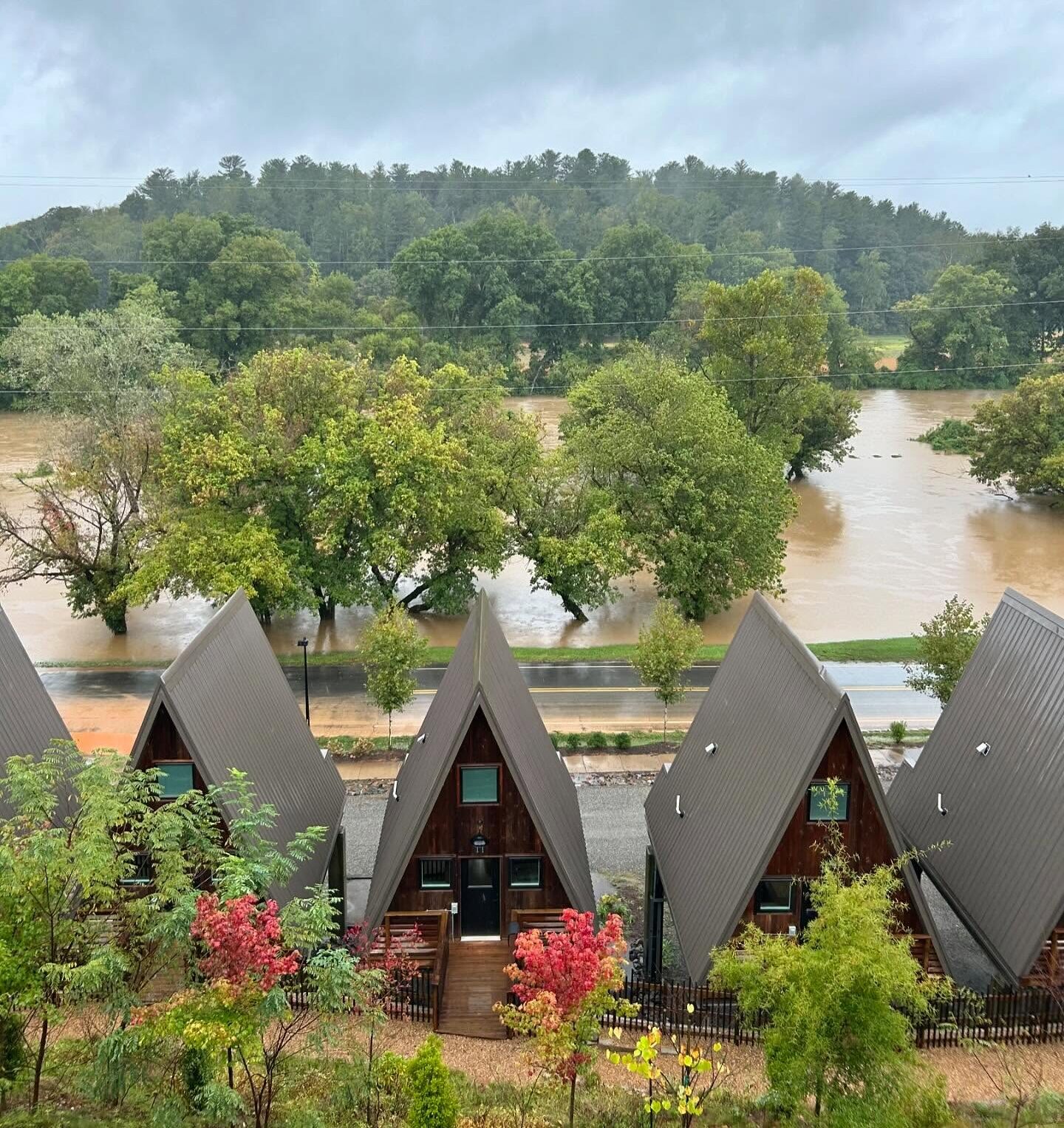
Wrong Way Campground also experienced flooding to their property, although thanks to intentional flood-resilient design, their lodge and cabins survived the French Broad River cresting over 24 feet. Learn more about Wrong Way’s compelling journey to recovery after Helene.

Other FREE educational events to support Helene-impacted communities:

Space is limited for these community events, so participants are encouraged to register early to secure a spot.

Visit our online event calendar to learn more about our others upcoming trainings, workshops, and community gatherings.

As we remember Hurricane Helene, let us also remember how our communities came together. Let us honor the kindness that emerged in the midst of hardship and the resilience that continues to carry us forward.

Still WNC Strong


Two years later, we continue to be inspired by the countless people who helped carry our communities through the hardest days:

  • The first responders who answered urgent calls.
  • The healthcare workers who cared for those in need.
  • The educators who supported children amidst uncertainty.
  • The utility crews, public servants, nonprofit leaders, behavioral health providers, faith communities, volunteers, and neighbors who showed up day after day.

THANK YOU to these heroes and helpers whose compassion, courage, and commitment helped light the way forward. Your legacy of service and the countless stories of neighbors helping neighbors continue to define our region today.

Resources for Resilience remains committed to supporting communities as they navigate the ongoing impacts of disaster, stress, and trauma.


Over the past two years, Western North Carolina has demonstrated something remarkable, through the reconstruction and recovery process.

We have become stronger together. We have learned to appreciate things we once took for granted. Most importantly, we have witnessed the extraordinary power of human connection.

The road ahead is still long, but the spirit of Appalachia remains steadfast—rooted in grit, resilience, determination, generosity, and hope.

May we never forget our capacity to rebuild, regenerate, heal, and grow.

Yesterday, today, and tomorrow, we remain #WNCStrong.


Additional Resources

Mantener La Calma Durante La Tormenta: Herramientas Prácticas Para Manejar El Estrés y La Ansiedad Relacionados Con El Clima

Mantener La Calma Durante La Tormenta: Herramientas Prácticas Para Manejar El Estrés y La Ansiedad Relacionados Con El Clima

El clima extremo no solo afecta las casas, carreteras y líneas eléctricas, sino también a nuestros sistemas nerviosos.

Los sobrevivientes del huracán Helene saben de primera mano que si has vivido un desastre natural, nuevas tormentas pueden generar más que solo el estrés logístico de la preparación.

Las alertas de emergencia, cielos cambiantes, largas filas y estantes vacíos pueden activar rápidamente el sistema de detección de amenazas del cerebro y provocar mucha agobio y ansiedad sobre lo que está por venir.

Incluso cuando estás a salvo, tu cuerpo puede reaccionar como si el peligro estuviera ocurriendo de nuevo: corazón acelerado, dificultad para dormir o ponerse en acción para prepararse para el peor escenario posible.  

Estamos aquí para recordarte que no estás solo. Todas estas son respuestas normales ante el estrés y al trauma. Y hay maneras simples, respaldadas por la ciencia, que pueden ayudar a tu sistema nervioso a calmarse y estabilizarse durante los momentos difíciles.

  • REINICIA el cuerpo dando un paseo, tomando una bebida, moviéndote de lado a lado o levantando o cargando algo pesado.
  • RECUERDA un momento que inspire seguridad, alegría o conexión del pasado.
  • CONECTA con seres queridos, compañeros de trabajo y vecinos revisando cómo están y co-regulándose juntos. ¡Las mascotas también cuentan!
  • PRACTICA la autocompasión: “Mi cuerpo está recordando algo real y quiere mantenerme a salvo.”

¿Quieres aprender más sobre estas herramientas rápidas pero poderosas? Únete a un próximo entrenamiento o taller GRATIS, o SUSCRIBETE o FOLLOW para mantenerte conectado.

¡Mantente seguro, abrigado y en contacto allá afuera! Juntos superaremos esto. 

Staying Calm Through the Storm: Practical Tools to Manage Weather-Related Stress & Anxiety

Staying Calm Through the Storm: Practical Tools to Manage Weather-Related Stress & Anxiety

Extreme weather doesn’t just affect homes, roads, and power lines — it affects our nervous systems.

For people who have lived through hurricanes, floods, wildfires, or prolonged outages, the body often remembers long after the storm has passed. Emergency alerts, darkening skies, rising winds, or even preparation routines can activate stress responses before we consciously realize what’s happening.

That’s why simple, consistent nervous system care matters — especially now more than ever when we live in a time and place that is vulnerable to natural disasters.

At Resources For Resilience, our trainings, workshops, and professional development programs focus on practical, science-based tools that help people calm their nervous systems quickly during moments of stress or overwhelm. These tools are especially relevant for disaster preparation and recovery, when emotions and uncertainty can run high.

In a 2025 survey, mental health provider Thriveworks found 25% of respondents ranked climate change and natural disasters as key sources of anxiety.

Why Nervous System Regulation Matters In Extreme Weather

When a storm approaches, the brain’s threat system (the amygdala) shifts into high alert. This response is designed to keep us safe — but for people with prior disaster trauma, it can stay activated even when danger has passed.

The body learns safety through repetition and through small, intentional moments of grounding. These micro-pauses — moments where we breathe, notice, and reconnect to our surroundings — send powerful signals to the brain: “There’s no immediate threat. It’s safe to slow down.”

Over time, these signals help expand our capacity to handle future stress, which is the foundation of resilience.

Up to 12% of people in the United States have anxiety disorders — or phobias — related to the weather, including an estimated 2% to 3% with storm phobia, according to a 2014 study in the Bulletin of the American Meteorological Society

What Are Rapid Resets?

Rapid Resets are Resources for Resilience™ signature, body-based tools designed to help regulate the nervous system when it becomes activated (anxious, panicked, overwhelmed) or shut down (numb, frozen, disconnected).

They are:

  • Simple

  • Accessible anywhere

  • Backed by neuroscience

  • Useful before, during, or after a storm

These tools don’t require special equipment, long sessions, or prior training — making them especially valuable during emergencies and recovery periods.

Who These Tools Are For

Rapid Resets can help ANYONE of any age or background, but they’re especially useful for people with limited access to traditional therapy, and for professionals who face regular occupational, work-related stress. They offer a quick way to steady the nervous system without stepping away from daily responsibilities of the job.

Extreme weather now ranks as the World Economic Forum’s #1 long‑term global risk. Hazardous weather conditions and dangerous climate extremes not only pose threats to human life, wildlife, economies, but they also disrupt transportation, communication systems, and other critical infrastructure. Of course, this affects our nervous systems too.


When to Use Rapid Resets

Anytime you notice signs that you’re outside your Resilient Zone, it may be time to reset. These signs include:

  • Racing or pounding heart

  • Shallow or labored breathing

  • Tight chest, jaw, shoulders, or stomach

  • Racing or repetitive thoughts

  • Feeling numb, frozen, or disconnected

  • Heightened sensitivity to noise or touch

  • Hyperviligence- overfunctioning or overpreparing

Rapid Reset Tools for Storm Stress & Recovery

You don’t need to use every tool, every time. Even one or two can gently shift how your body responds during stressful moments.

Connect

The research has show time and again that we regulate best with others, not alone. After a stressful weather event or preparation period, connecting with a trusted person helps the nervous system receive the message: “You’re not alone. You’re safe now.” Shared breathing, conversation, touch, or even sitting quietly together can help systems synchronize and soften.

Sense In

Bring attention inward. Scan your body from feet to head and notice where you feel most neutral or at ease. Observing without judgment helps interrupt stress spirals and brings the thinking brain back online.

Ground

Sit, stand, or lie on something solid. Notice how your body is supported by the ground, a chair, or a wall. Let gravity do some of the work. You don’t have to hold everything up alone.

Orient

Slowly look around your environment. Notice shapes, colors, sounds, or light. Turning your head and scanning the space helps signal to the brain that the present moment is different from the past.

Take a Sip

Drinking water — especially warm liquids — engages multiple sensory pathways. Notice the weight, temperature, and sensation of swallowing as a way to anchor yourself in the present.

Sing or Hum

Vocalization stimulates the vagus nerve, helping calm the nervous system. Humming, singing, or chanting (alone or with others) can be especially grounding during high-stress moments.

Tap Side-to-Side

The “Butterfly Hug” uses bilateral stimulation to promote relaxation. Gently tap alternating sides of your body at a pace that feels calming.

Take a Walk

Walking helps discharge stress through movement. Pay attention to your steps, breathing, and muscle movement — especially helpful after intense weather events or long days of recovery work.

Do Heavy Work

Engaging large muscles through pushing, lifting, sweeping, gardening, or cleaning helps release stored stress and restore a sense of strength and agency.

Push Against a Wall

Using your body’s strength to push against something solid can help release excess energy and bring a sense of stability.

*Of course if you’re in an unsafe area or hazardous conditions, follow all official guidance from national and local meteorological agencies and prioritize safety.

Why These Tools Work

All of these practices help regulate the nervous system — the foundation for how we think, feel, and respond during emergencies. When the body settles, decision-making improves, communication becomes clearer, and preparation becomes more effective.

With consistent use, these tools:

  • Shorten recovery time after stress

  • Reduce the intensity of trauma responses

  • Increase confidence in future disaster preparedness

  • Build long-term resilience

Simple Tools. Powerful Results.

Other Helpful Reminders To Support Your Mental Well‑Being

Severe weather can impact mental health long after the storm passes. Staying connected, checking in on one another, and offering practical support strengthens our community and helps everyone recover—together.

  • Name What’s Happening. Practice self-compassion and acceptance that you are doing your best. Stress, anxiety, grief, anger, fear, and overwhelm are all normal responses to uncertainty and trauma. Recognizing your response as valid and physiological helps reduce shame and guilt while naming and labeling your emotions can help your brain understand the bigger picture and process your feelings. 

  • Rebuild Safety in your Space. Prepare a storm plan or supply list, connect with your “pod”, and create cues of stability and steadiness, such as opening the curtains to let natural light in.

    • Maintain Your Routine. Follow your normal routine and keep a healthy rhythm of good sleep, healthy meals, and balanced activity. 

    • Cut Back on “Doom Scrolling”: Staying informed is helpful, but nonstop weather coverage and news can fuel anxiety. Take breaks to unplug, checking for updates at intermittent intervals instead of continuously.

    • Have Analog Activities Ready: Reading a book or simple leisure activities like puzzles, crafts, or coloring can redirect your mind and ease anxious thoughts. Slowing down also reminds your body and brain that there is no immediate urgency or threat.
  • Stay in Touch: Storms can feel isolating. Reach out to neighbors, friends or family by phone or video to check in and provide mutual comfort and reassurance. Ask open-ended questions to those in need of support with meals, rides, cleaning, or childcare: “What do you need most right now?”

Resources for Resilience offers FREE weekly Listening Circles to help people navigate stress of all types. This is a space to learn, but most importantly to feel seen, heard, and connected.

  • Seek Professional Support When Needed: If stress or overwhelm feels too heavy, many confidential free resources are available. Don’t be afraid to reach out if you’re feeling particularly overwhelmed or fearful, or you simply need someone to talk to. You deserve immediate support no matter what you’re facing.

Preparing For the Next Storm

Extreme weather is more than just an environmental talking point — it has become one of the most significant long‑term threats to global stability. Its prominence and prevalence signals how urgently we need to strengthen both practical and emotional resilience for communities and critical systems everywhere.

Weather-related trauma isn’t just about the loss and disruption that happens during the storm. It also includes the aftermath and the lasting impact of grief and uncertainty.

By practicing nervous system regulation, we strengthen our capacity to respond rather than react to the next disaster that will inevitably come our way. This is not only helpful for ourselves, but also for our families, loved ones, and our communities.

With these science-backed tools there is real hope for healing and recovery, and that’s why we do what we do. We think everyone, everywhere can use this valuable information!

To learn more about our signature educational workshops and trainings, subscribe to our email list or explore our event calendar.

We look forward to supporting you — before, during, and after the storm.

RELATED POSTS

When The Storm Doesn’t End: Understanding Weather-Related Trauma

When The Storm Doesn’t End: Understanding Weather-Related Trauma

For a long time, trauma had a different name. It was once called shell shock, a term used to describe soldiers who returned from war changed by what they had seen and survived. Today, we understand this experience more clearly as Post-traumatic Stress Disorder...

When The Storm Doesn’t End: Understanding Weather-Related Trauma

When The Storm Doesn’t End: Understanding Weather-Related Trauma

For a long time, trauma had a different name. It was once called shell shock, a term used to describe soldiers who returned from war changed by what they had seen and survived. Today, we understand this experience more clearly as Post-traumatic Stress Disorder (PTSD)—a condition that can emerge after someone lives through, witnesses, or is repeatedly exposed to a traumatic event.

At its core, PTSD is what happens when the body and mind struggle to return to safety after danger has passed. It often shows up when a person begins reliving the trauma—through memories, nightmares, flashbacks, or intense emotional and physical reactions—long after the event itself is over.

While PTSD is commonly associated with combat veterans, we now know it can affect anyone, at any age, and that trauma comes in many forms. One of the most overlooked causes is natural disasters and extreme weather events.

Helpful reframe: Think of post-traumatic stress not as a ‘disorder’, but as an injury.


Trauma Isn’t Just What Happens to You—It’s What Happens Inside You

PTSD doesn’t require a single “worst-case” experience. It can develop after:

  • Directly experiencing a traumatic event
  • Losing loved ones, homes, or livelihoods
  • Working as a first responder or helper during a disaster
  • Witnessing destruction in your community day after day
  • Repeatedly hearing stories or seeing images of the event

For many people, trauma doesn’t arrive all at once. It builds. The mind keeps revisiting what happened, trying to make sense of it. Over time, this can lead to symptoms like:

  • Nightmares or intrusive memories
  • Trouble sleeping
  • Feeling constantly on edge or hyper-alert
  • Emotional numbness or disconnection
  • Deep exhaustion
  • Dissociation, or feeling outside your own body

When these symptoms persist, they may be diagnosed as PTSD.

“Trauma can serve as a catalyst for growth and resilience, enabling individuals to develop new coping skills, deeper relationships, and a greater appreciation for life.”
Steven Southwick

PTSD Awareness Matters—Especially After Disasters

PTSD is often misunderstood. Many people minimize their experience, telling themselves:

  • “Others had it worse.”
  • “I should be over this by now.”
  • “It was just a bad storm.”

But trauma isn’t a competition. Even losing power, food, routines, or a sense of safety can deeply affect the nervous system. Secondary or vicarious trauma—being indirectly affected—counts, too.

Raising awareness helps people recognize symptoms early, before they worsen, and reminds us that healing is possible.

Natural Disasters and the Phases of Trauma

Experiencing a natural disaster follows a fairly predictable emotional pattern, even though everyone’s experience is unique.

Phase One: Impact (During Event)
This is the moment the weather disaster hits. There may be fear for safety, confusion, disbelief, or shock.

Phase Two: Immediate Aftermath (Days to Weeks Later)
Survival takes priority. Communities come together. Adrenaline is high. Numbness is common once the immediate danger passes.

Phase Three: Intermediate Recovery (Weeks to Months Later)
This phase often brings both hope and frustration. There’s generosity and outside help—but also exhaustion, inequity, and disillusionment. People may begin noticing physical symptoms like sleep issues, digestive problems, and chronic fatigue.

Phase Four: Long-Term Recovery (Months to Years Later)
This is where many people are now. Life is being rebuilt, but stress lingers. Fears about the future increase. PTSD symptoms may surface or intensify as reminders remain everywhere—damaged places, anniversaries, weather forecasts, or seasonal changes.

When you’ve lived through a weather disaster, your brain learns that impending weather can become dangerous very quickly. This affects our nervous systems, and the way we respond to and process what’s happening around us.

Common survival responses and reactions may include:

  • Feeling anxious or tense when storms are forecast or weather conditions shift
  • Tracking systems and checking for updates and alerts more often
  • Over-preparing emergency supplies or safety plans
  • Downplaying risk, minimizing new threats, or denying the possibility of danger

All of these reactions make sense!

Hurricane Helene: A Shared Trauma That Still Lives With Us

Hurricane Helene is a powerful example of weather-related trauma for Western North Carolinians. Over a year later, many people are still surrounded by reminders of what happened—damaged areas, changed landscapes, ongoing recovery efforts, and lingering losses.

For some, every new storm will reopen old wounds and bring anxiety, hypervigilance, or fear they can’t explain. These reactions don’t mean you’re weak—they simply mean your body remembers.

As we face future storms, it’s important to recognize that recovery isn’t just physical or economic—it’s emotional. Preparing for what’s ahead must include caring for mental health, building community connections, and acknowledging the invisible scars disasters leave behind.

The storm may have passed, but healing takes time. And no one has to do it alone.

“It’s been raining nonstop here in Western North Carolina for days. Tonight our creeks and rivers started flooding—and you can feel it: everyone is remembering Hurricane Helene. The relentless water. The roads and bridges destroyed. The lives, houses, and cars washed away. The temporary fixes of roads and bridges post-Helene are exposing their weaknesses tonight.
A rainstorm here is no longer just rain falling. It’s hours of holding our collective breath. It’s the long tail of ongoing stress. It’s checking Facebook to see if a neighbor has posted an update: damage, washouts, trees down, water rising. It’s losing internet and wondering if we’ll lose cell service too. And power. And I don’t even have to check with my neighbors to know what we’re all doing, because we’re all doing the same thing: waiting, bracing, running the checklist: How much food is in the fridge? How much water do we have? Is there enough gas in the cars? In the UTV? Is the chainsaw ready? Do the walkie talkies have batteries? How much propane is in the tank? Because underneath all the practical questions is the one we don’t want to ask out loud: How long can we last on our own?
The hardest thing about living through a natural disaster is that you already know the worst-case scenario. And somehow, it’s also the best thing—because you have a clearer idea of how to prepare.
A prayer for Western North Carolina
God of mercy, Be near to every household listening to the rain and remembering what it cost us before. Calm the waters. Strengthen the banks. Protect the roads and bridges that are already fragile. Cover our first responders, linemen, and neighbors who will show up in the dark with courage and compassion. Protect the vulnerable: babies, elders, those living alone, and those carrying invisible trauma from the last storm. And for every nervous system bracing for impact, bring peace that is steady and real. Give us wisdom, clear thinking, and the help we need when we need it. Make us a people who move toward one another in support and compassion. Amen.”
Emma Churchman

What Helps Build Resilience

Grief, anger, sadness, and fear are all valid responses to stressful or traumatic events. Healing does not mean forgetting—it means learning how to live again with what you’ve survived.

While PTSD can be serious, there are several research-based practices that help reduce its long-term impact:

  • Sensing In: This is about paying attention and getting curious about what your body is telling you with subtle messages. Because we’re wired for survival, our nervous systems are already masterful at noticing sensations of discomfort or pain, but it’s helpful to interrupt that pattern and shift the focus to the positive, comfortable, or neutral. What do you notice in your breathing, your heart rate, your muscle tension?
  • Connecting: Avoid isolation. Talk openly to loved ones, neighbors, and strangers about what happened. Connect with yourself too! Loving self-talk goes a long way: “I survived a disaster once, and I know I can do it again, especially because I learned so much.” “Looking around, I can see that I am safe right now and that’s what’s important.” “Even though it’s stressful sometimes, I am really good at finding creative solutions to problems and overcoming challenges that arise.”
  • Moving: Simple, body-based practices, or ‘Rapid Resets’, can be used to shift and redirect your energy. This includes things like tapping side to side, pushing against something sturdy, or humming to activate the vagus nerve.
  • Reaching Out: Trained mental health professionals can provide the expertise, knowledge, and support to help you work through the stress and emotional impact of extreme weather.
 

Surviving natural disasters wasn’t a muscle you ever intended to develop, but through life experience and practice you’re stronger than before.

You Don’t Have to Walk Through This Alone — We’re Here for You

You’ve survived the storm, now take care of yourself — body, mind, and heart.

Healing is a journey, and there are neighbors and professionals ready to walk with you every step of the way.

If you’re still feeling the emotional impact of Hurricane Helene—or the stress and trauma from any natural disaster—you don’t have to go it alone. There are real, accessible, and often FREE resources right here in Western North Carolina designed to support you, your family, and your community as you heal.

Behavioral Health & Immediate Crisis Support

Local organizations, educational posts, and wellness events are helpful, but they are NOT a replacement for therapy with a licensed mental health practitioner.

No matter what you’re experiencing, if you’re feeling overwhelmed, isolated, needing someone to lean on, or experiencing symptoms of PTSD that are disruptive to everyday life, 24/7/265 professional help and confidential support are available through various crisis lifelines and warmlines.

Trauma-Informed Support

Now through June 2026, Resources For Resilience is offering FREE events and practical tools to help individuals and communities build emotional strength and cope with stress after Helene and other weather-related trauma.

These no-cost workshops and trainings are available throughout the region and are designed to help you understand how your body and mind respond to stress and how to support yourself and others through recovery.

Will you join us?


Related posts

When The Storm Doesn’t End: Understanding Weather-Related Trauma

When The Storm Doesn’t End: Understanding Weather-Related Trauma

For a long time, trauma had a different name. It was once called shell shock, a term used to describe soldiers who returned from war changed by what they had seen and survived. Today, we understand this experience more clearly as Post-traumatic Stress Disorder...

Scared, But Not Alone: Helping Kids Feel Safe & Connected During Extreme Weather Events

Scared, But Not Alone: Helping Kids Feel Safe & Connected During Extreme Weather Events

Parents and caregivers play a powerful role in shaping how children experience stressful or unpredictable weather events like hurricanes, flooding, wildfires, or other natural disasters.

When adults stay grounded and regulated, kids naturally take their cues from that steadiness. Even in moments of uncertainty, simple, consistent tools can help families feel more connected and secure.


Mental Health Practices for Parents & Children

The programming of Resources For Resilience teaches several practices that parents can use with children when storms stir up fear, memories, or anxiety. Practicing these tools regularly — not just during storms — helps build resilience over time. Kids learn that even when the weather is unpredictable, they have ways to feel safe, supported, and confident navigating whatever comes next.

Use Rapid Resets Together

Gentle tapping, humming, or taking a sip of water can help settle the nervous system. When kids see a calm adult using a Rapid Reset, the tool becomes even more effective. Kids need small moments of relief — play, laughter, and breaks from the heaviness help their bodies and minds recover.

Help Them Sense In

Curiosity goes a long way. This pulls their attention out of fear and back into the present, where their body can begin to settle. In particular, we want them to notice what feels good, comfortable, or even just neutral. Our nervous systems are already masterful at noticing sensations of discomfort or pain for survival reasons, but we want to help them shift the focus to the positive.

Recall A Comforting Memory

Invite kids to think about a favorite place, person, or moment. Remembered safety helps the brain shift out of a stress state and back toward calm.

Look For The Helpers

Pointing out neighbors, responders, or community members who are helping interrupts the brain’s threat response. Noticing safety and support in the environment helps the body relax.

Stay Connected

A calm voice, a cuddle, reading together, or a quick check-in can regulate a child’s nervous system faster than anything else. Connection is one of the most powerful antidotes to fear.

Normalize Their Feelings

Let kids know their reactions make sense. Reassurance helps them feel understood and supported. Phrases like these can help:

    • “I understand why you are afraid. I’m here with you.”
    • “Yes, this is scary. Helene was scary, too — and do you remember how we got through it? We’re even stronger now.”
    • “Everyone feels scared sometimes, and that’s okay. Our bodies are doing their job.”
    • “We’re paying attention. We’re ready to handle whatever comes our way.”
    • That was really scary.  You were scared, and I was scared, and many of our neighbors were too.”
    • “Thankfully our nervous systems are keeping us safe.”

Process Together

Parents can’t prevent every hard moment for their children, but they can help kids by staying present with them and asking them simple questions about what they feel or need. Being open and honest in an age-appropriate way matters more than trying to shield them. They’re going to see and hear things, and what helps most is talking afterward and making sense of it together. Reminder: It’s normal for kids to want to retell stories over and over. While it may feel repetitive to you, know that it’s part of how they’re “metabolizing’ and making sense of things.

Practice Self-Compassion

Just like our children, most parents are learning as they go, and that’s completely okay. If we’ve never even been through something before, of course we won’t know how to do it perfectly. Every family will move through hard times differently, so giving grace and patience is important.

Limit Media Consumption

After a storm, or any weather disaster is a good time for everyone to unplug and spend time together with friends and family. If children are exposed to media about the event, view it with them and offer reassuring explanations and answer any questions. It’s important not to not provide too many details or share graphic images or emotional coverage.

Age-Appropriate Responses

Young children often look to adults for cues on how to respond to stressful events, while teens will have other unique needs and coping styles. Understanding these processing and developmental differences helps ensure everyone receives the support they need to heal, adapt, and recover.

  • Ages 0-5:
    • Provide comfort, routines, and reassurance that trusted adults are keeping them safe.
    • Use simple, honest language and answer questions briefly.
    • Encourage play, drawing, or storytelling to express feelings.
  • Ages 6-12:
    • Invite them to talk about what happened and how they feel.
    • Correct misconceptions and provide age-appropriate facts.
    • Maintain routines when possible and involve them in recovery activities.
    • Watch for changes in behavior, sleep, appetite, or school performance.
  • Ages 3-18:
    • Acknowledge their emotions and give them opportunities to discuss concerns.
    • Encourage healthy coping strategies such as exercise, creative outlets, and peer support.
    • Involve them in preparedness and community recovery efforts to build a sense of control.
    • Monitor for signs of prolonged anxiety, depression, or risky behaviors.
Regardless of the age of the child, you can support them by Listening without judgment, validating feelings, providing accurate information, maintaining routines and normalcy whenever possible.


Wrapping It Up

Extreme weather can shake a family’s sense of safety, but no one has to navigate it alone. Resources For Resilience™ offers simple, practical tools that help parents and youth stay grounded and supported through fear, uncertainty, and recovery.

If you’re looking for ways to strengthen your family’s resilience — before, during, or after a storm — we’re here to help.

Explore our family‑focused workshops and our community trainings, and walk away with easy‑to‑use practices designed to restore calm and clarity for people of all ages. Together, we can help your family feel more prepared, more supported, and more confident facing whatever comes next.

The good news? Kids are resilient. However, it’s also not that simple. In situations that feel out of our control, it’s important to remember that children take their cues from adults. We hold so much influence in a child’s ability to regulate and bounce back.


Additional Resources

‘Storm on Sesame Street’ episode | PBS KIDS

Hurricanes & Floods: Taking Care of Your Children and Yourself | HealthyChildren.org

College Students Coping After the Hurricane | The National Child Traumatic Stress Network

Immediate Mental Health Support Resources


RELATED POSTS

When The Storm Doesn’t End: Understanding Weather-Related Trauma

When The Storm Doesn’t End: Understanding Weather-Related Trauma

For a long time, trauma had a different name. It was once called shell shock, a term used to describe soldiers who returned from war changed by what they had seen and survived. Today, we understand this experience more clearly as Post-traumatic Stress Disorder...

Hitting “Close To Home”: How to Cope With The Emotions of Extreme Weather, Especially If You’ve Lived It Before

Hitting “Close To Home”: How to Cope With The Emotions of Extreme Weather, Especially If You’ve Lived It Before

As survivors of Hurricane Helene will tell you, past trauma has a way of “compressing time.” Extreme weather can stir up more than logistical stress — for many people, it brings back memories of past storms, evacuations, losses, or long recoveries.

When something was overwhelming the first time, reminders can collapse the distance between “then” and “now.” A person may know they’re safe, but their body may still shift into survival mode — faster heart rate, shallow breathing, irritability, trouble sleeping, or a sense of dread.

Even when we’re physically safe, our bodies may react as if danger is already here. That response is normal. It’s human. And it makes sense.

Why Extreme Weather Can Feel So Intense

For anyone who has lived through a natural disaster such as a hurricane, flood, wildfire, earthquake, or prolonged power outage, the body remembers. The amygdala — the brain’s threat detector — is designed to scan for danger and react quickly. When it recognizes familiar cues (emergency alerts, dark skies, increasing winds, long lines at the store), it may shift into survival mode before you even realize it. For Helene survivors in particular, that collective activation can feel like déjà vu.

That doesn’t mean you’re overreacting. It means your nervous system is doing its job.

People with weather-related or natural disaster trauma may face judgement from themselves or others for being “too sensitive,” “paranoid,” or “overpreparing,” but their reactions make sense. The nervous system remembers past events, so similar sensory experiences can trigger old survival responses.

Your brain and body are trying to protect you by staying alert, planning ahead, and controlling whatever it can.  This may look like:

  • stocking up more than what’s needed
  • double‑checking supplies
  • tracking forecasts more closely
  • obsessing over details
  • worrying about things you never noticed before

Those behaviors are natural instincts and survival responses, normal reactions to having been through something traumatic or overwhelming.

The good news: you can help your nervous system settle and move out of survival mode and into your Resilient Zone.

Over time, as your sense of safety rebuilds, the intensity of those urges to overprepare usually softens.

The amygdala doesn’t distinguish between past and present; it only recognizes patterns that once signaled danger.

‘Amped Up’ vs ‘Shut Down’

While many people go into hyperviligence and anxious action-mode to prepare for the worst, there can also be an opposite response of avoidance, denial, downplaying risks, or minimizing new weather alerts.
Ultimately this has the same goal: the brain trying to protect itself from overwhelming stress. Sometimes the nervous system simply becomes so exhausted from being on alert that it swings in the opposite direction and tries to shut out reminders of any threat.
After experiencing a previous natural disaster, shut-down might look like:
  • Ignoring weather alerts
  • Delaying preparations or putting off emergency planning until the last minute
  • Avoiding the news or weather apps altogether
  • Feeling emotionally numb about new warnings
  • Telling yourself that everyone else is over-reacting
  • Believing, “I can’t go through that again, so I’m not going to think about it”
  • Convincing yourself that it’s not a big deal
This doesn’t mean you don’t care about your life, or aren’t taking danger seriously. Remember: your nervous system is doing its best to protect you. Give yourself grace by understaning and acknowledging your emotions. Stay informed, make a plan, and return your attention to the present moment as much as possible.
Not everyone responds to stress the same way. For disaster survivors, you may enter into either an ‘amped up’ or ‘shut-down’ state, and both are signs that a past experience may still affecting the nervous system. If either response is causing significant distress or making it difficult to stay safe during weather events, talking with a mental health professional can help.

Practices To Regulate the Nervous System

When emergency weather alerts or storm preparations start to activate old memories, there are simple practices that can help your brain and body find stillness and steadiness again.

Reset The Body

When stress rises, the body often needs support before the mind can catch up. Small, sensory-rich actions can interrupt the stress response and help the nervous system rebalance.

Try:

    • Gentle side-to-side tapping
    • Holding or lifting a heavy object
    • Taking a slow sip of water
    • Humming or making a low, steady sound

These actions become even more effective when you pay attention to the details — the weight of the object in your hands, the temperature of the water, the vibration of your voice. As the amygdala calms, the thinking part of your brain comes back “online,” making it easier to communicate, plan, and problem-solve.

Recall a Positive Memory

It may sound simple, but remembering a heartwarming moment of joy, safety, or connection can shift your body out of a stress state. The brain responds to remembered safety almost the same way it responds to real safety.

You can also remember to “look for the helpers.” Chances are that there are people in the community supporting and checking in on each other, and this fact alone can give your brain evidence that safety, trust, hope, and connection still exist and that you’re not facing the situation alone.

When you interrupt a negative thought loop with something warm or grounding — a favorite place, a loved one’s voice, a moment you felt proud — you’re signaling to your system that it’s okay to return to calm. This is especially helpful when the alerts or coverage start to feel overwhelming.

Connect With Others

Humans are wired for connection, and this is one of the most powerful antidotes to stress. Safe connection is one of the most direct ways to soothe the amygdala and help the body settle.

This works with:

    • Friends
    • Family
    • Neighbors
    • Coworkers
    • Pets (yes, animals count — they help regulate us too!)

A quick check-in, shared laugh, a long hug, or supportive conversation can lower stress hormones and remind your nervous system that you’re not alone.

Practice Self-Compassion

Understanding what you can and can’t control is a powerful way to calm weather-related stress because it gives your brain clarity about what’s yours to manage — and what isn’t.

    • Focus on what you can control: taking practical steps, preparing your space, gathering supplies, making evacuation plans, choosing who you’re with, reaching out for support, and using grounding tools. These actions give your nervous system a sense of agency.
    • Name what you can’t control: the storm’s path, other people’s reactions, or the memories your body brings up. Acknowledging these limits reduces self-blame and helps stop the mind from spinning.
    • Be gentle with yourself: Common judgments — like “I should be over this” or “No one else reacts like this” — overlook or minimize what you lived through. Treating yourself with compassion helps your body settle and supports healing over time. This sounds like:
      • “My body is remembering something real.”
      • “This reaction is about my history, not my character.”
      • “It’s okay to feel this way, and I deserve compassion and care.”
      • “I am doing all that I can to prepare.”
      • “I will get through this, heal, and move forward.”
      • “Every storm is different, and I’ve never been through this one before.”

As you do each of these things (reset, recall, connect, care) notice how you feel physically and emotionally. You may feel more relaxed, confident, calm or clear. Really paying attention to those physical sensations helps solidify the practice in place.


Why These Tools Work

All of these practices help regulate the nervous system — the foundation of how we think, feel, and respond to stress. When the body and mind settle together, it becomes easier to make decisions, communicate clearly, and move forward with confidence.

And there’s an even bigger benefit: When practiced consistently over time, these small actions expand our capacity to handle new stress that comes our way. Eventually the brain and body learn to move more quickly out of survival mode and into a steadier, more grounded state. This is the essence of resilience!

Memories from Helene

Survivors of Hurricane Helene here in North Carolina may feel particularly triggered by new threatening weather systems.

Helene wasn’t just an event — it was a full-body sensory experience filled with sights, sounds, smells, and other physical sensations. And any similar experience of today can reactivate all of those stored memories from the past.

We experienced first-hand how quickly conditions can change. That lived experience can make new forecasts feel more uncertain or ominous, even if the current storm is less severe. The nervous system becomes primed to anticipate the worst because it has seen how bad things can get.

There’s also the thought of another long, painful, and exhausting recovery. A new storm may stir up the emotional residue of that entire post-storm period, not just the event itself. Helene wasn’t just the storm — it was the aftermath:

  • displacement
  • property damage
  • financial strain
  • compromised hygiene
  • illness
  • disrupted routines
  • widespread loss
  • long-term rebuilding

Families and communities across Western North Carolina are still healing from Helene over a year later. We are still recovering and rebuilding physically, financially, AND emotionally. So a new storm feels like damage on top of an already-fresh wound.

During ‘Winter Storm Fern’ in January 2026, the RFR team experienced this PTSD-like trauma firsthand. And across the internet and through discussions with eachother, neighbors, friends and family, we realized that we were not the only ones feeling anxious and amped up being reminded of Helene.

Here is what real WNC residents are saying out there:

  • Storm prep in WNC hits different after Helene… We remember.”
  • I’m scared about the ice storm. I have to act like I’m not for my kids so I’m saying it here.”
  • “I just filled up my old Helene water jugs and I want to vomit.”
  • “I know I’ll be fine but still sitting in the parking lot at the grocery store all teary-eyed because I’m tired of doing this prep work alone.”
  • “I have water, food, blankets, flashlights etc but I broke down multiple times today and realize I’m having a PTSD response.”
  • “The trauma coming up is terrifying.”
  • “Planning on doing a last load of laundry and washing my hair tomorrow in case we don’t have water. Those were never on my storm prep before.”
  • “Pulling out my emergency items from Helene and same 😵‍💫”
  • “My soul… is tired.”
  • Helene. The ice storm of 2002. And the blizzard of ’93. I would much rather be needlessly overprepared that caught without.”
  • It was only ~15 months ago. We’re still traumatized and don’t want to feel so stuck and helpless again.”
  • “Yeah, we’re not feelin so hot.”
  • “I really don’t want to hear trees breaking or falling. That was an awful sound.”
  • “The anxiety ebbs and flows. Definitely upticks when I’m out in public and the collective shared PTSD is palpable. But I feel a little bit better knowing that I’m prepping from a place of experience.”
  • “It is definitely triggering something within me! I feel so anxious, like all of the time!””
  • “It comes in waves mixed with denial.”
  • “Storm anxiety is REAL!”
  • “We’re gonna be okay, but we’re also gonna freak out a bit AND be prepared.”
  • “I don’t think I will ever feel adequately prepped. My teenager is so traumatized she keeps asking if we have enough food and candles and water and did I remember fresh batteries for the flashlights. It’s completely altered us.”
  • “I hate it so much. Wide awake by 4 each night.”
  • “I’ve been doing all the prepping and I have no idea what we’re gonna get. My anxiety is so high.”
  • “I’ve got some jitters, but most of my anxiety is secondhand. My husband is prepping like civilization is a limited edition and the recall just dropped. Batteries, water, solemn glances. I’m nervous too, but laughing feels like a survival skill at this point.”
  • “Really tired of the burnout caused by natural disaster prep. Helene, the wildfires, now this, it just feels like another ‘hunker down and hope for the best.'”
  • “I’m just going to bury myself and my cat under ten blankets and hope it passes soon. I’m tired of preparing for disaster.”
  • “I’m too saturated to know the difference anymore.”

You’re Not Alone — And Your Reactions Make Sense

If extreme weather brings up old feelings or physical reactions, there is nothing wrong with you. Your body is remembering. And you can support it with simple, accessible tools that help you reconnect to safety, steadiness, and community.

At Resources for Resilience, we work with individuals, teams, and communities across North Carolina to help people manage stress, prevent burnout, and build resilience in themselves and others. We offer simple, research-based tools and trainings that help the brain and body settle during moments of overwhelm.

If you’re ready to deepen your own resilience or help others strengthen theirs:

RELATED POSTS

When The Storm Doesn’t End: Understanding Weather-Related Trauma

When The Storm Doesn’t End: Understanding Weather-Related Trauma

For a long time, trauma had a different name. It was once called shell shock, a term used to describe soldiers who returned from war changed by what they had seen and survived. Today, we understand this experience more clearly as Post-traumatic Stress Disorder...