When Hurricane Helene devastated Western North Carolina in September 2024, the impacts extended far beyond damaged roads, homes, and infrastructure. Months after the storm, residents, caregivers, volunteers, educators, healthcare professionals, and community leaders continued to carry the emotional weight of recovery. Chronic stress, grief, burnout, compassion fatigue, and uncertainty became ongoing challenges for many of the people helping communities rebuild.
To address these needs, Resources For Resilience, in collaboration with Vaya Health and the NC Department of Health & Human Services, mobilized a region-wide effort to provide free, trauma-informed resilience education across Western North Carolina. Thanks to support from these funders and multiple community partners, RFR was able to deliver practical tools and strategies designed to help people understand stress, strengthen well-being, and support others through recovery.
Between January and June 2026, RFR offered six different resilience-focused trainings in workplaces, schools, healthcare settings, government agencies, community organizations, and virtual spaces. An independent evaluation conducted by Prevention Strategies offers evidence of the impact this work has had on individuals and communities throughout the region.
Prevention Strategies
Prevention Strategies is a North Carolina-based research, evaluation, and consulting organization founded in partnership with UNC Greensboro. Their team of research scientists and public health professionals help organizations measure the effectiveness of their commuinity programs, translating prevention science and behavioral research into meaningful, practical outcomes.
Meeting Critical Recovery Needs
As a nonprofit serving communities since 2017, Resources For Resilience was able to respond quickly following Hurricane Helene.
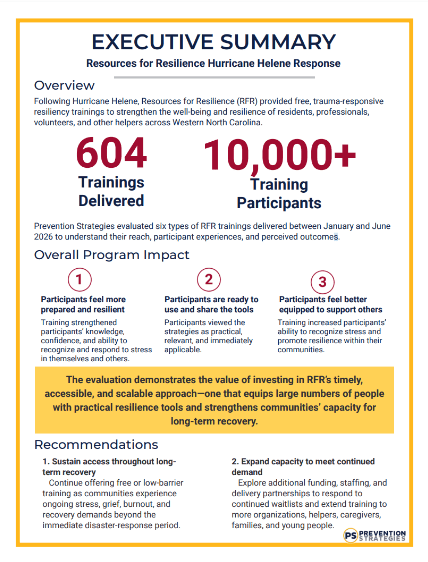
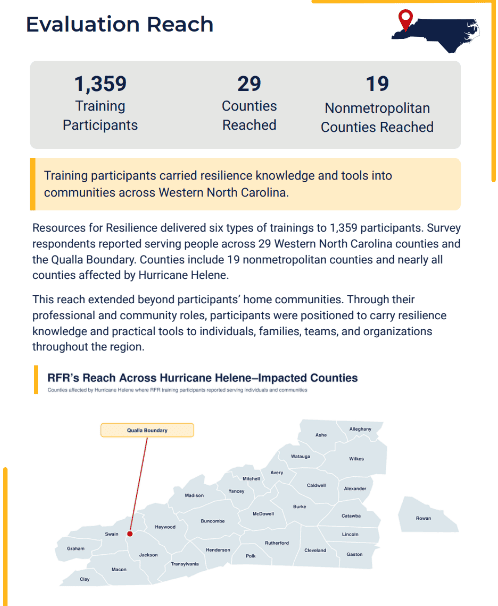
During the GROW NC funding period alone, the organization delivered more than 1,000 hours of live, interactive programming, reaching more than 10,000 residents, professionals, volunteers, and helpers across 29 counties and the Qualla/Cherokee Boundary. They partnered with more than 70 organizations, including 50 new community partners, and provided more than 600 training opportunities throughout Western North Carolina.
Today, the demand remains strong, with waitlists and continued requests demonstrating that resilience support remains a critical part of long-term disaster recovery.
Disaster recovery is not measured only by rebuilding structures. It is also measured by communities’ ability to adapt, maintain connection, support one another, and move forward together.
Evaluating Results & Impacts
To better understand the effectiveness of the trainings, Resources for Resilience partnered with Prevention Strategies to evaluate participant experiences and outcomes related to the following trainings between January and June 2026:
- Reconnecting Through Hard Times (682 participants)
- Leading Through Hard Times (213 participants)
- Recharging Resilience (180 participants)
- Reconnect for Better Days (152 participants)
- Reconnect for Resilience (100 participants)
- Resiliency Champions (32 participants)
Surveys were administered before and after trainings to measure changes in knowledge, confidence, and preparedness.
The evaluation focused on whether participants:
- Increased their understanding of stress and resilience
- Felt more prepared to recognize and respond to stress in themselves and others
- Gained practical tools for managing burnout, compassion fatigue, and toxic stress
- Planned to use resilience strategies in their daily lives
- Intended to share what they learned with colleagues, clients, families, and communities
The evaluation captured data from 1,359 training participants representing communities across 29 Helene-impacted counties in Western North Carolina counties, including 19 rural counties.
More than half of participants (52%) reported that this was their first resilience training experience.
Participants Felt More Prepared and Resilient
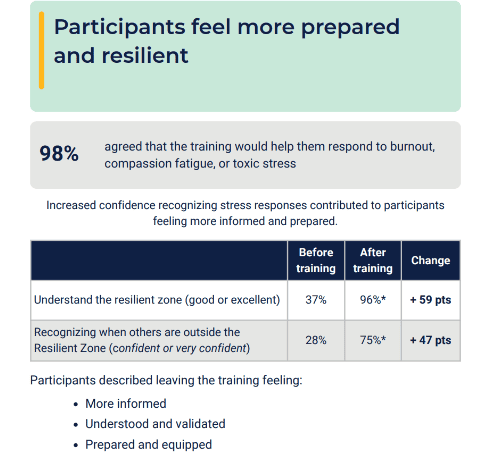
One of the strongest findings from the evaluation was the significant increase in participants’ understanding of stress and resilience. Participants frequently described feeling:
- More informed and aware
- Better understood and validated
- More confident and equipped
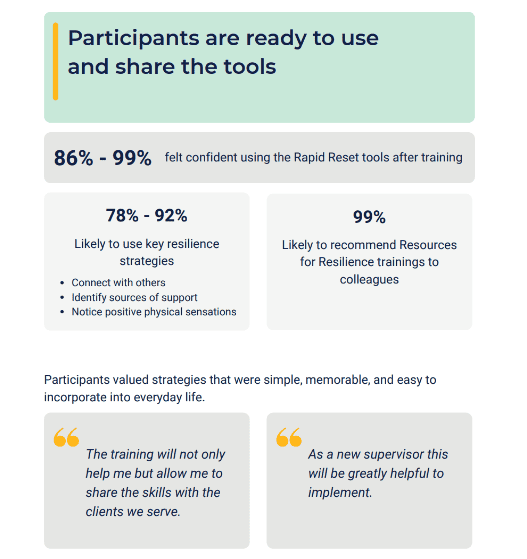
Participants also consistently highlighted the value of practical, easy-to-implement resilience strategies, which included:
- Connecting with supportive people
- Identifying sources of support
- Practicing rapid-reset techniques
- Noticing positive physical sensations
- Building awareness of stress responses
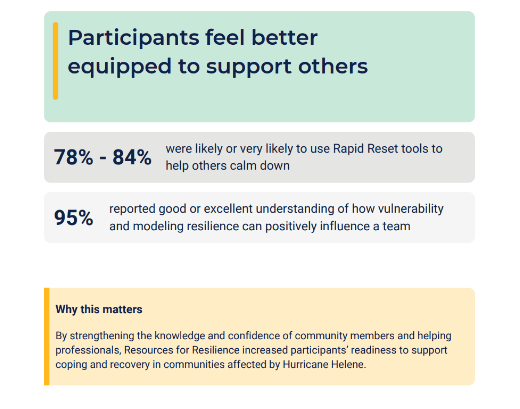
Lastly, the evaluation found that the impact of the trainings extended beyond individual well-being. Participants reported they were likely to use resilience strategies to help others around them regulate stress, supporting coworkers, clients, students, families, and community members.
The findings underscore an important lesson: helping the helpers. Communities recover more effectively when the people providing support receive support themselves.
When key community player have the knowledge, skills, tools, and supportive resources they need to manage stress and burnout in themselves, they are better able to sustain the care and leadership that their communities need and rely on.
In other words, when we help these people care for themselves, they can better care for others and the impacts trickle outwards.
The study demonstrates the powerful role resilience education can play in public health.While this evaluation focused on WNC, the findings have broader implications for disaster recovery globally, helping individuals, teams and communities maintain their well-being and strengthen valuable social connections.
By the Numbers
- 10,000+ people across 29 counties reached through resilience education and support in WNC
- 96% of participants understood the Resilient Zone after training, up from 37% before training.
- 98% felt better prepared to respond to burnout, compassion fatigue, and toxic stress.
- 99% would recommend Resources For Resilience trainings to colleagues.
Participant Experiences:
“This training made me feel seen and heard and understand myself better.”
“I have been operating in the Survival Brain for months and months at work. There are helpful tools to go to now thanks to this training.”
“I am excited to use these tools in my professional and personal life. I already use some of the tools and I am glad to add more to my toolbox.”
“It taught me how to help and support others while also taking care of myself.”
Because many participants worked as service-based professionals (educators, first responders, healthcare providers, nonprofit staff, community leaders, etc), the benefits of the trainings extended far beyond those who attended. Participants carried resilience knowledge and practical skills back into their organizations, workplaces, families, and communities.
Looking Ahead
The study confirms what many participants and partners have experienced firsthand: resilience education is playing a valuable role in Western North Carolina’s recovery from Hurricane Helene, and it’s doing that one person, one organization, and one community at a time.
As communities continue to face stress, grief, burnout, and recovery-related challenges long after the initial disaster, maintaining free or low-barrier training opportunities remains essential.
Additional funding, staffing, and partnerships could help Resources For Resilience expand their capacity to meet demand, reaching more organizations and reduce growing waitlists.
NEXT STEPS