Study Finds Resilience Education Increases Confidence, Connection, and Recovery After Community Disaster
When Hurricane Helene devastated Western North Carolina in September 2024, the impacts extended far beyond damaged roads, homes, and infrastructure. Months after the storm, residents, caregivers, volunteers, educators, healthcare professionals, and community leaders continued to carry the emotional weight of recovery. Chronic stress, grief, burnout, compassion fatigue, and uncertainty became ongoing challenges for many of the people helping communities rebuild.


To address these needs, Resources For Resilience, in collaboration with Vaya Health and the NC Department of Health & Human Services, mobilized a region-wide effort to provide free, trauma-informed resilience education across Western North Carolina. Thanks to support from these funders and multiple community partners, RFR was able to deliver practical tools and strategies designed to help people understand stress, strengthen well-being, and support others through recovery.

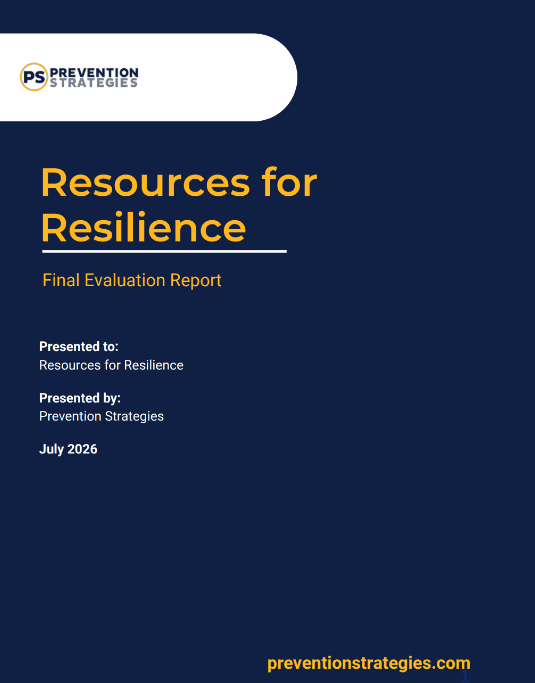
Between January and June 2026, RFR offered six different resilience-focused trainings in workplaces, schools, healthcare settings, government agencies, community organizations, and virtual spaces. An independent evaluation conducted by Prevention Strategies offers evidence of the impact this work has had on individuals and communities throughout the region.

Prevention Strategies


Prevention Strategies is a North Carolina-based research, evaluation, and consulting organization founded in partnership with UNC Greensboro. Their team of research scientists and public health professionals help organizations measure the effectiveness of their commuinity programs, translating prevention science and behavioral research into meaningful, practical outcomes.


    Meeting Critical Recovery Needs

    As a nonprofit serving communities since 2017, Resources For Resilience was able to respond quickly following Hurricane Helene.

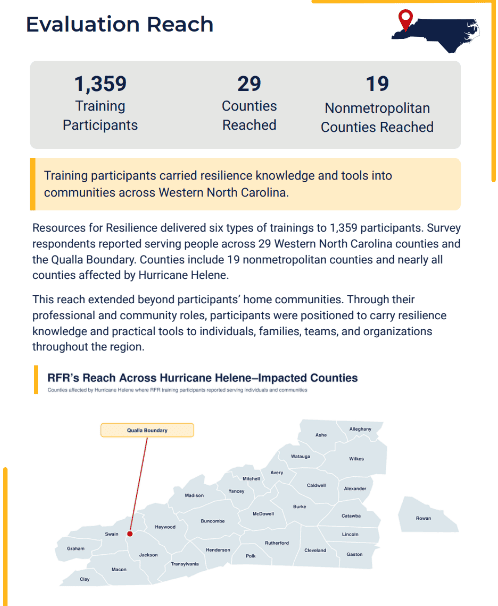
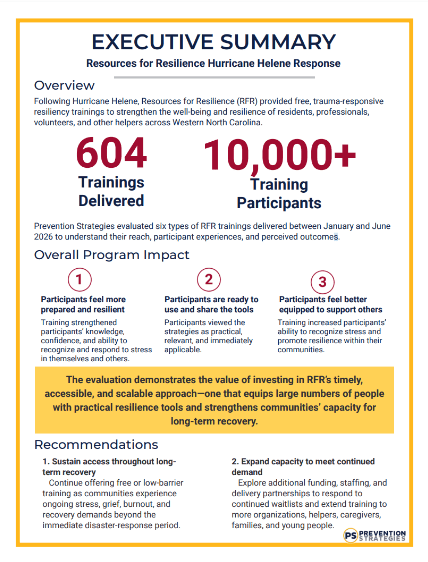
    During the GROW NC funding period alone, the organization delivered more than 1,000 hours of live, interactive programming, reaching more than 10,000 residents, professionals, volunteers, and helpers across 29 counties and the Qualla/Cherokee Boundary. They partnered with more than 70 organizations, including 50 new community partners, and provided more than 600 training opportunities throughout Western North Carolina.

    Today, the demand remains strong, with waitlists and continued requests demonstrating that resilience support remains a critical part of long-term disaster recovery.

    Disaster recovery is not measured only by rebuilding structures. It is also measured by communities’ ability to adapt, maintain connection, support one another, and move forward together.

    Evaluating Results & Impacts

    To better understand the effectiveness of the trainings, Resources for Resilience partnered with Prevention Strategies to evaluate participant experiences and outcomes related to the following trainings between January and June 2026:

    • Reconnecting Through Hard Times (682 participants)
    • Leading Through Hard Times (213 participants)
    • Recharging Resilience (180 participants)
    • Reconnect for Better Days (152 participants)
    • Reconnect for Resilience (100 participants)
    • Resiliency Champions (32 participants)

    Surveys were administered before and after trainings to measure changes in knowledge, confidence, and preparedness.

    The evaluation focused on whether participants:

    • Increased their understanding of stress and resilience
    • Felt more prepared to recognize and respond to stress in themselves and others
    • Gained practical tools for managing burnout, compassion fatigue, and toxic stress
    • Planned to use resilience strategies in their daily lives
    • Intended to share what they learned with colleagues, clients, families, and communities

    The evaluation captured data from 1,359 training participants representing communities across 29 Helene-impacted counties in Western North Carolina counties, including 19 rural counties.


    More than half of participants (52%) reported that this was their first resilience training experience.

    Participants Felt More Prepared and Resilient

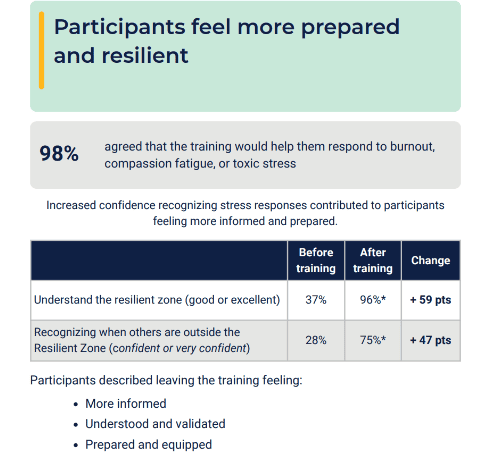
    One of the strongest findings from the evaluation was the significant increase in participants’ understanding of stress and resilience. Participants frequently described feeling:

    • More informed and aware
    • Better understood and validated
    • More confident and equipped

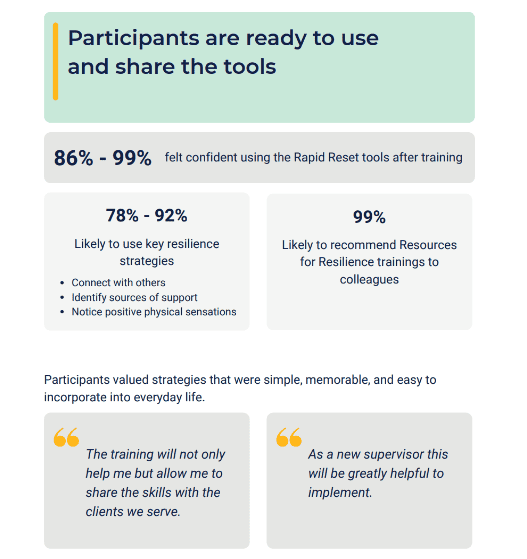
    Participants also consistently highlighted the value of practical, easy-to-implement resilience strategies, which included:

    • Connecting with supportive people
    • Identifying sources of support
    • Practicing rapid-reset techniques
    • Noticing positive physical sensations
    • Building awareness of stress responses

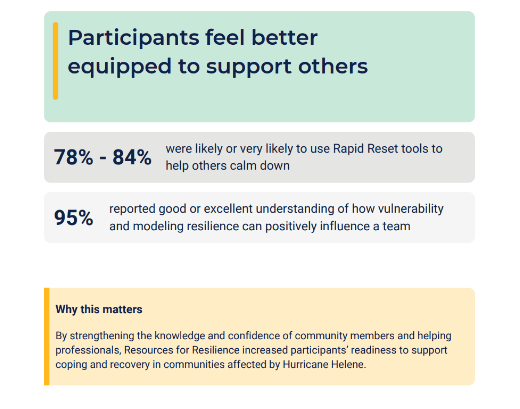
    Lastly, the evaluation found that the impact of the trainings extended beyond individual well-being. Participants reported they were likely to use resilience strategies to help others around them regulate stress, supporting coworkers, clients, students, families, and community members.

    The findings underscore an important lesson: helping the helpers. Communities recover more effectively when the people providing support receive support themselves.

    When key community player have the knowledge, skills, tools, and supportive resources they need to manage stress and burnout in themselves, they are better able to sustain the care and leadership that their communities need and rely on.

    In other words, when we help these people care for themselves, they can better care for others and the impacts trickle outwards.


    The study demonstrates the powerful role resilience education can play in public health.While this evaluation focused on WNC, the findings have broader implications for disaster recovery globally, helping individuals, teams and communities maintain their well-being and strengthen valuable social connections.


    By the Numbers

    • 10,000+ people across 29 counties reached through resilience education and support in WNC
    • 96% of participants understood the Resilient Zone after training, up from 37% before training.
    • 98% felt better prepared to respond to burnout, compassion fatigue, and toxic stress.
    • 99% would recommend Resources For Resilience trainings to colleagues.


    Participant Experiences:

    “This training made me feel seen and heard and understand myself better.”

    “I have been operating in the Survival Brain for months and months at work. There are helpful tools to go to now thanks to this training.”

    “I am excited to use these tools in my professional and personal life. I already use some of the tools and I am glad to add more to my toolbox.”

    “It taught me how to help and support others while also taking care of myself.”


    Because many participants worked as service-based professionals (educators, first responders, healthcare providers, nonprofit staff, community leaders, etc), the benefits of the trainings extended far beyond those who attended. Participants carried resilience knowledge and practical skills back into their organizations, workplaces, families, and communities.


    Looking Ahead

    The study confirms what many participants and partners have experienced firsthand: resilience education is playing a valuable role in Western North Carolina’s recovery from Hurricane Helene, and it’s doing that one person, one organization, and one community at a time.

    As communities continue to face stress, grief, burnout, and recovery-related challenges long after the initial disaster, maintaining free or low-barrier training opportunities remains essential.

    Additional funding, staffing, and partnerships could help Resources For Resilience expand their capacity to meet demand, reaching more organizations and reduce growing waitlists.

    NEXT STEPS
    Managing Holiday Stress, The RFR Way

    The holiday season is often filled with moments of joy, connection, and celebration. It can also bring long to-do lists, family dynamics, travel demands, financial pressures, and heightened expectations.

    While many people look forward to the holidays, it’s equally common to experience stress, sadness, grief, or overwhelm during this time of year.

    At Resources For Resilience, we believe resilience is not about eliminating stress or forcing ourselves to feel cheerful all the time. Instead, resilience is our ability to notice what we’re experiencing, support our nervous system, and return to a place of balance and well-being.

    The good news? Small, intentional actions can make a big difference. By practicing simple, science-informed tools throughout the season, we can show up with greater calm, presence, and compassion for ourselves and those around us.

    The Holidays and Your Nervous System

    The holidays place extra demands on our minds and bodies. Busy schedules, social gatherings, travel, financial concerns, and emotional memories can all activate our stress response.

    When stress accumulates, our nervous systems may begin sending signals that we’re overwhelmed or operating beyond our capacity.

    You might notice:

    • A racing heart or rapid breathing
    • Tightness in your jaw, shoulders, chest, or stomach
    • Irritability or racing thoughts
    • Feeling numb, frozen, or emotionally shut down
    • Increased sensitivity to noise, crowds, or touch
    • Exhaustion that doesn’t seem to go away

    These responses are not signs that something is wrong with you. They are normal biological reactions to stress.

    When we intentionally create moments of safety and regulation, we help our bodies shift out of survival mode and back toward a state of connection, flexibility, and calm.

    Give Yourself Grace

    Many people enter the holiday season carrying invisible burdens. Grief, financial stress, caregiving responsibilities, loneliness, difficult family relationships, or recovery from recent challenges can make this time of year especially difficult.

    Name It to Tame It

    Simply acknowledging your feelings can reduce their intensity. Try saying:

    • “I’m feeling overwhelmed.”
    • “I’m exhausted.”
    • “This is a hard day.”
    • “This time of year is not my favorite.”

    Naming your experience helps create awareness and perspective.

    Practice Self-Compassion

    Speak to yourself the way you would speak to someone you love. Replace self-criticism with kindness and understanding. You don’t have to earn rest and rewards, and you don’t have to be productive every moment of the season.

    Honor Your Limits

    Healthy boundaries protect your energy. Give yourself permission to:

    • Leave gatherings early
    • Take breaks during busy days
    • Rest without guilt
    • Ask for help
    • Decline invitations

    Rapid Resets For Holiday Stress

    Rapid Resets are brief, body-based practices that help regulate the nervous system. They can be used anytime and almost anywhere, whether you’re preparing for a family gathering, navigating a crowded store, sitting in holiday traffic, or recovering after a busy day.

    Even one small reset can help interrupt the stress cycle and support your well-being.

    1. Sense In

    Pause and gently notice your body from head to toe. Ask yourself: “Where do I feel most neutral, steady, or at ease right now?”

    Rather than focusing only on discomfort, this practice helps your brain recognize areas of safety and stability.

    2. Ground

    Sit, stand, or lean against something sturdy. Notice the support beneath you. Feeling physically supported can help you feel emotionally supported, too.

    3. Orient

    Slowly look around the space you’re in. Notice colors, shapes, lighting, textures, or sounds of interest. Let your eyes and neck move naturally as you scan your environment. This helps signal to your nervous system that you are in the present moment.

    4. Take a Sip

    Slow down and enjoy a drink mindfully. Notice its temperature, taste, and how it feels as you swallow. Warm beverages can be especially soothing during colder months.

    5. Hum or Sing

    Hum your favorite tune, sing along to a holiday song, or whistle softly. Gentle vocal vibrations stimulate the vagus nerve, a key pathway involved in calming the stress response.

    6. Tap Side-to-Side

    Give yourself a “Butterfly Hug’ and tap your shoulders while you do it. Alternately tap your knees, or arms in a steady rhythm. This simple bilateral movement can help reduce feelings of anxiety and bring you back into the present moment.

    7. Take A Walk

    Take a walk or march in place for a few minutes. Movement helps discharge built-up stress energy while supporting emotional regulation.

    8. Do Heavy Work

    Engage large muscle groups by carrying groceries, cleaning, shoveling snow, moving boxes, or lifting items around the house. Purposeful physical effort can help release tension and create a sense of grounding.

    9. Push Against a Wall

    Place your hands against a wall and gently push. Notice your strength, the pressure in your muscles, and the solid support beneath your hands.


    “Holiday Mantra: I am prioritizing Connection over Perfection”

    The Power of Connection & Care


    In a season that often encourages us to do more, buy more, and accomplish more, it’s important to remember that we are wired for connection.

    Meaningful relationships and supportive interactions help calm our nervous systems and strengthen resilience.

    Rather than focusing on creating a flawless holiday experience, focus on being present with the people who matter most!

    Practical Ways to Foster Connection This Holiday Season:

    • Reach out to someone you care about for a conversation, check-in, or shared activity.
    • Prioritize presence over perfection by focusing on meaningful moments instead of flawless plans.
    • Spend time with trusted people who help you feel safe, accepted, and understood.
    • Practice co-regulation through shared laughter, a long hug, supportive conversation, or simply being together.
    • Offer small acts of kindness, such as checking on a neighbor, helping a friend, or lending a listening ear.
    • Share a meal or activity with family, friends, or community members to strengthen connections.
    • Ask for support when you need it and allow others the opportunity to care for you.
    • Create space for gratitude and appreciation by letting loved ones know they matter to you.
    A warm conversation,  or even quiet companionship can help reduce stress and restore a sense of balance. These small acts of connection not only support others but also nurture our own well-being.


    Look For Holiday Magic 

    ‘Glimmers’ are small moments that bring a sense of comfort, joy, hope, or peace.

    You might notice:

    • Sunlight through a window
    • A favorite seasonal scent
    • A cherished holiday tradition
    • A meaningful song
    • A child’s laughter
    • A warm cup of coffee on a cold morning

    These seemingly small experiences can help signal safety and regulation to the brain and body.

    Be gentle with yourself this season. Slow down when you can, connect where it matters, and remember: resilience grows one small moment at a time.

    Small Practices, Lasting Impact

    This holiday season, remember that your well-being matters. Choose one or two practices that feel manageable and meaningful. Repeat them often. Notice what helps you feel more grounded, connected, and supported.

    Resilience is not built through grand gestures. It develops through small, repeatable moments of care and connection. Even brief moments of pause send powerful messages of safety to your brain and body.

    At Resources For Resilience, we believe that everyone deserves practical tools for navigating stress and strengthening well-being. Our programs offer simple, accessible strategies to help individuals, families, schools, workplaces, and communities build resilience during the holidays and throughout the year.