When The Storm Doesn’t End: Understanding Weather-Related Trauma

When The Storm Doesn’t End: Understanding Weather-Related Trauma

For a long time, trauma had a different name. It was once called shell shock, a term used to describe soldiers who returned from war changed by what they had seen and survived. Today, we understand this experience more clearly as Post-traumatic Stress Disorder (PTSD)—a condition that can emerge after someone lives through, witnesses, or is repeatedly exposed to a traumatic event.

At its core, PTSD is what happens when the body and mind struggle to return to safety after danger has passed. It often shows up when a person begins reliving the trauma—through memories, nightmares, flashbacks, or intense emotional and physical reactions—long after the event itself is over.

While PTSD is commonly associated with combat veterans, we now know it can affect anyone, at any age, and that trauma comes in many forms. One of the most overlooked causes is natural disasters and extreme weather events.

Helpful reframe: Think of post-traumatic stress not as a ‘disorder’, but as an injury.


Trauma Isn’t Just What Happens to You—It’s What Happens Inside You

PTSD doesn’t require a single “worst-case” experience. It can develop after:

  • Directly experiencing a traumatic event
  • Losing loved ones, homes, or livelihoods
  • Working as a first responder or helper during a disaster
  • Witnessing destruction in your community day after day
  • Repeatedly hearing stories or seeing images of the event

For many people, trauma doesn’t arrive all at once. It builds. The mind keeps revisiting what happened, trying to make sense of it. Over time, this can lead to symptoms like:

  • Nightmares or intrusive memories
  • Trouble sleeping
  • Feeling constantly on edge or hyper-alert
  • Emotional numbness or disconnection
  • Deep exhaustion
  • Dissociation, or feeling outside your own body

When these symptoms persist, they may be diagnosed as PTSD.

PTSD Awareness Matters—Especially After Disasters

PTSD is often misunderstood. Many people minimize their experience, telling themselves:

  • “Others had it worse.”
  • “I should be over this by now.”
  • “It was just a bad storm.”

But trauma isn’t a competition. Even losing power, food, routines, or a sense of safety can deeply affect the nervous system. Secondary or vicarious trauma—being indirectly affected—counts, too.

Raising awareness helps people recognize symptoms early, before they worsen, and reminds us that healing is possible.

Natural Disasters and the Phases of Trauma

Experiencing a natural disaster follows a fairly predictable emotional pattern, even though everyone’s experience is unique.

Phase One: Impact (During Event)
This is the moment the weather disaster hits. There may be fear for safety, confusion, disbelief, or shock.

Phase Two: Immediate Aftermath (Days to Weeks Later)
Survival takes priority. Communities come together. Adrenaline is high. Numbness is common once the immediate danger passes.

Phase Three: Intermediate Recovery (Weeks to Months Later)
This phase often brings both hope and frustration. There’s generosity and outside help—but also exhaustion, inequity, and disillusionment. People may begin noticing physical symptoms like sleep issues, digestive problems, and chronic fatigue.

Phase Four: Long-Term Recovery (Months to Years Later)
This is where many people are now. Life is being rebuilt, but stress lingers. Fears about the future increase. PTSD symptoms may surface or intensify as reminders remain everywhere—damaged places, anniversaries, weather forecasts, or seasonal changes.

Hurricane Helene: A Shared Trauma That Still Lives With Us

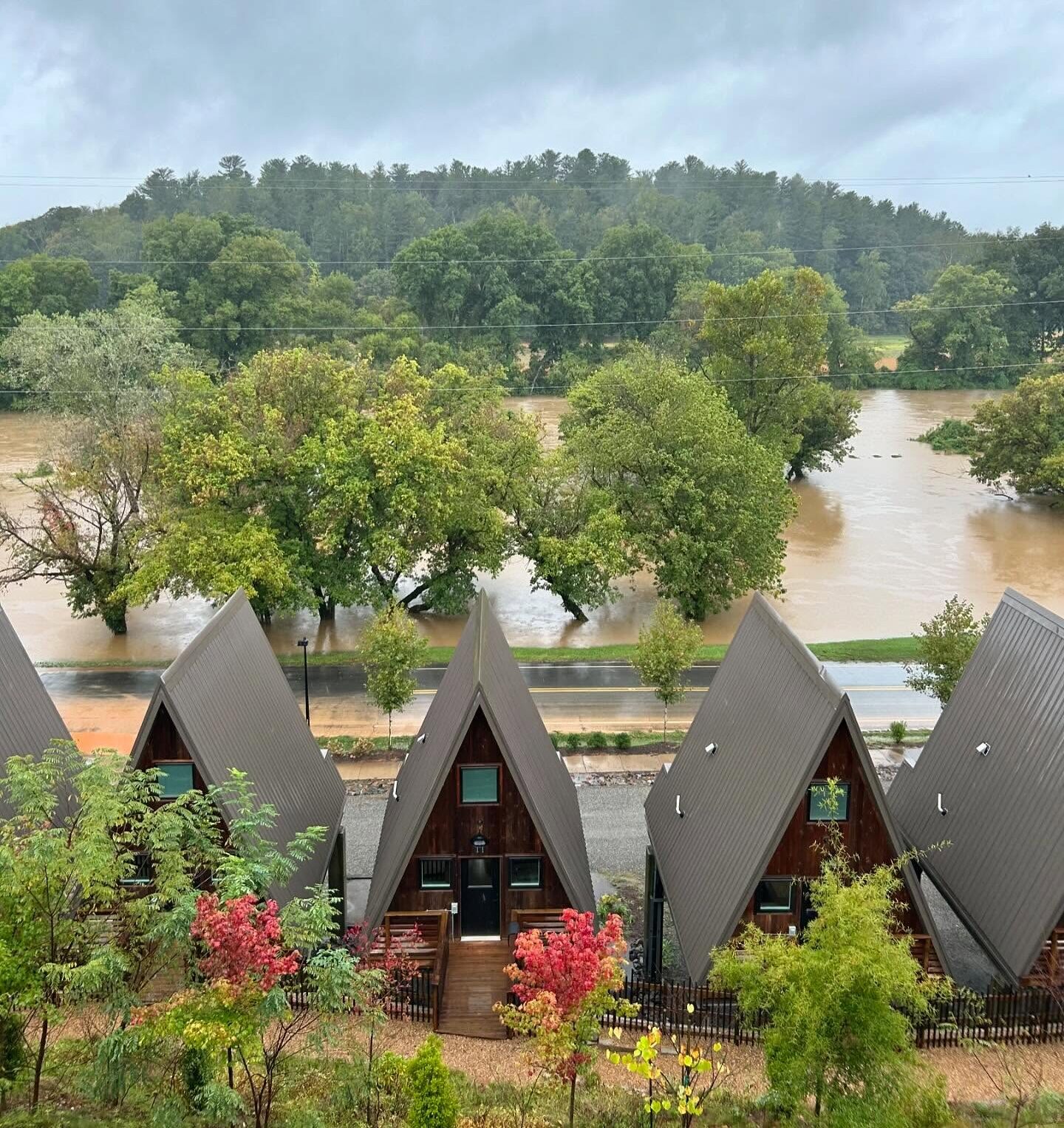
Hurricane Helene is a powerful example of weather-related trauma for Western North Carolinians. Over a year later, many people are still surrounded by reminders of what happened—damaged areas, changed landscapes, ongoing recovery efforts, and lingering losses.

For some, every new storm will reopen old wounds and bring anxiety, hypervigilance, or fear they can’t explain. These reactions don’t mean you’re weak—they simply mean your body remembers.

As we face future storms, it’s important to recognize that recovery isn’t just physical or economic—it’s emotional. Preparing for what’s ahead must include caring for mental health, building community connections, and acknowledging the invisible scars disasters leave behind.

The storm may have passed, but healing takes time. And no one has to do it alone.

What Helps Build Resilience

Grief, anger, sadness, and fear are all valid responses to stressful or traumatic events. Healing does not mean forgetting—it means learning how to live again with what you’ve survived.

While PTSD can be serious, there are several research-based practices that help reduce its long-term impact:

  • Sensing In: This is about paying attention and getting curious about what your body is telling you with subtle messages. Because we’re wired for survival, our nervous systems are already masterful at noticing sensations of discomfort or pain, but it’s helpful to interrupt that pattern and shift the focus to the positive, comfortable, or neutral. What do you notice in your breathing, your heart rate, your muscle tension?
  • Connecting: Avoid isolation. Talk openly to loved ones, neighbors, and strangers about what happened. Connect with yourself too! Loving self-talk goes a long way: “I survived a disaster once, and I know I can do it again, especially because I learned so much.” “Looking around, I can see that I am safe right now and that’s what’s important.” “Even though it’s stressful sometimes, I am really good at finding creative solutions to problems and overcoming challenges that arise.”
  • Moving: Simple, body-based practices, or ‘Rapid Resets’, can be used to shift and redirect your energy. This includes things like tapping side to side, pushing against something sturdy, or humming to activate the vagus nerve.
  • Reaching Out: Trained mental health professionals can provide the expertise, knowledge, and support to help you work through the stress and emotional impact of extreme weather.
 

Surviving natural disasters wasn’t a muscle you ever intended to develop, but through life experience and practice you’re stronger than before.

You Don’t Have to Walk Through This Alone — We’re Here for You

You’ve survived the storm, now take care of yourself — body, mind, and heart.

Healing is a journey, and there are neighbors and professionals ready to walk with you every step of the way.

If you’re still feeling the emotional impact of Hurricane Helene—or the stress and trauma from any natural disaster—you don’t have to go it alone. There are real, accessible, and often FREE resources right here in Western North Carolina designed to support you, your family, and your community as you heal.

Behavioral Health & Immediate Crisis Support

Local organizations, educational posts, and wellness events are helpful, but they are NOT a replacement for therapy with a licensed mental health practitioner.

No matter what you’re experiencing, if you’re feeling overwhelmed, isolated, needing someone to lean on, or experiencing symptoms of PTSD that are disruptive to everyday life, 24/7/265 professional help and confidential support are available through various crisis lifelines and warmlines.

Trauma-Informed Support

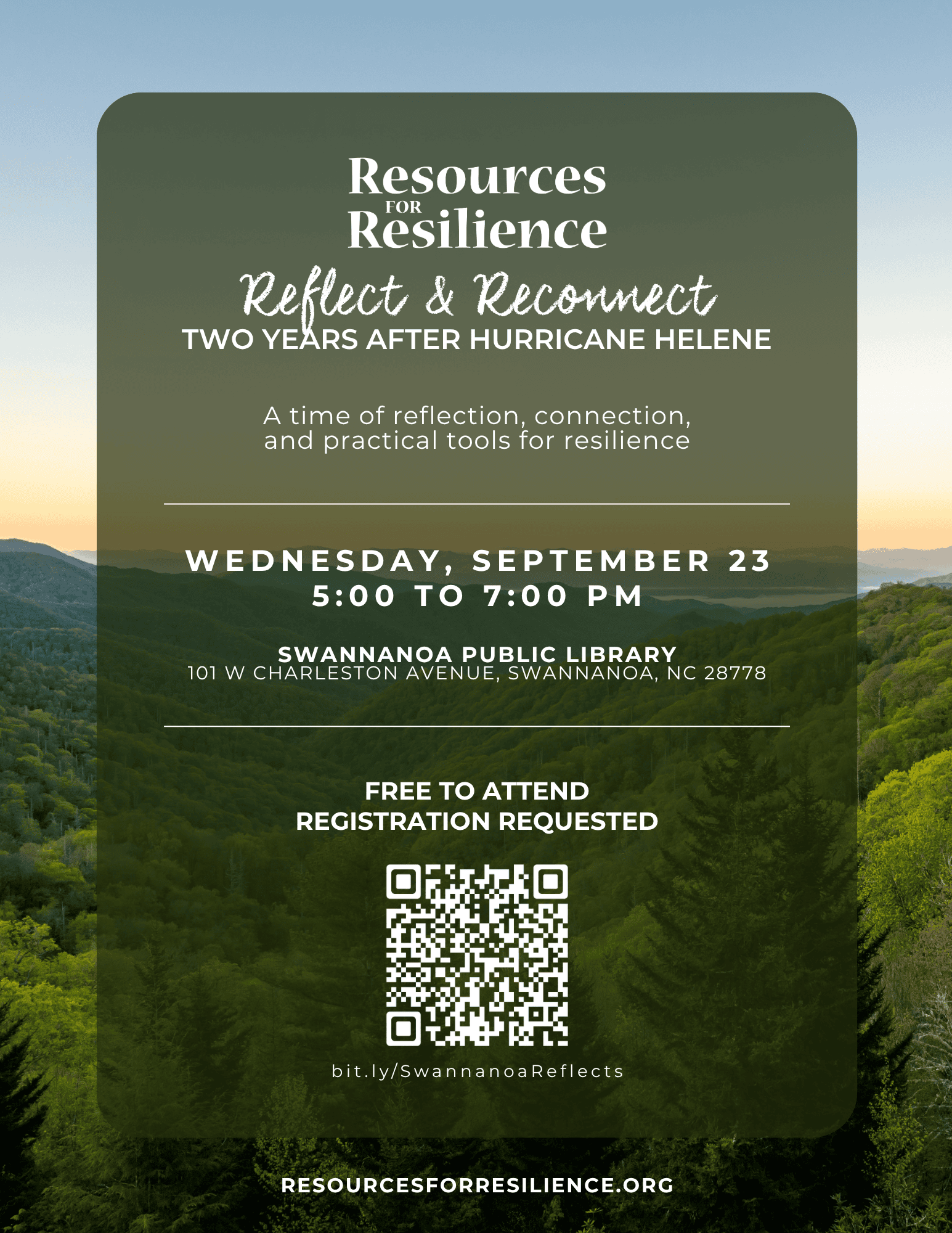
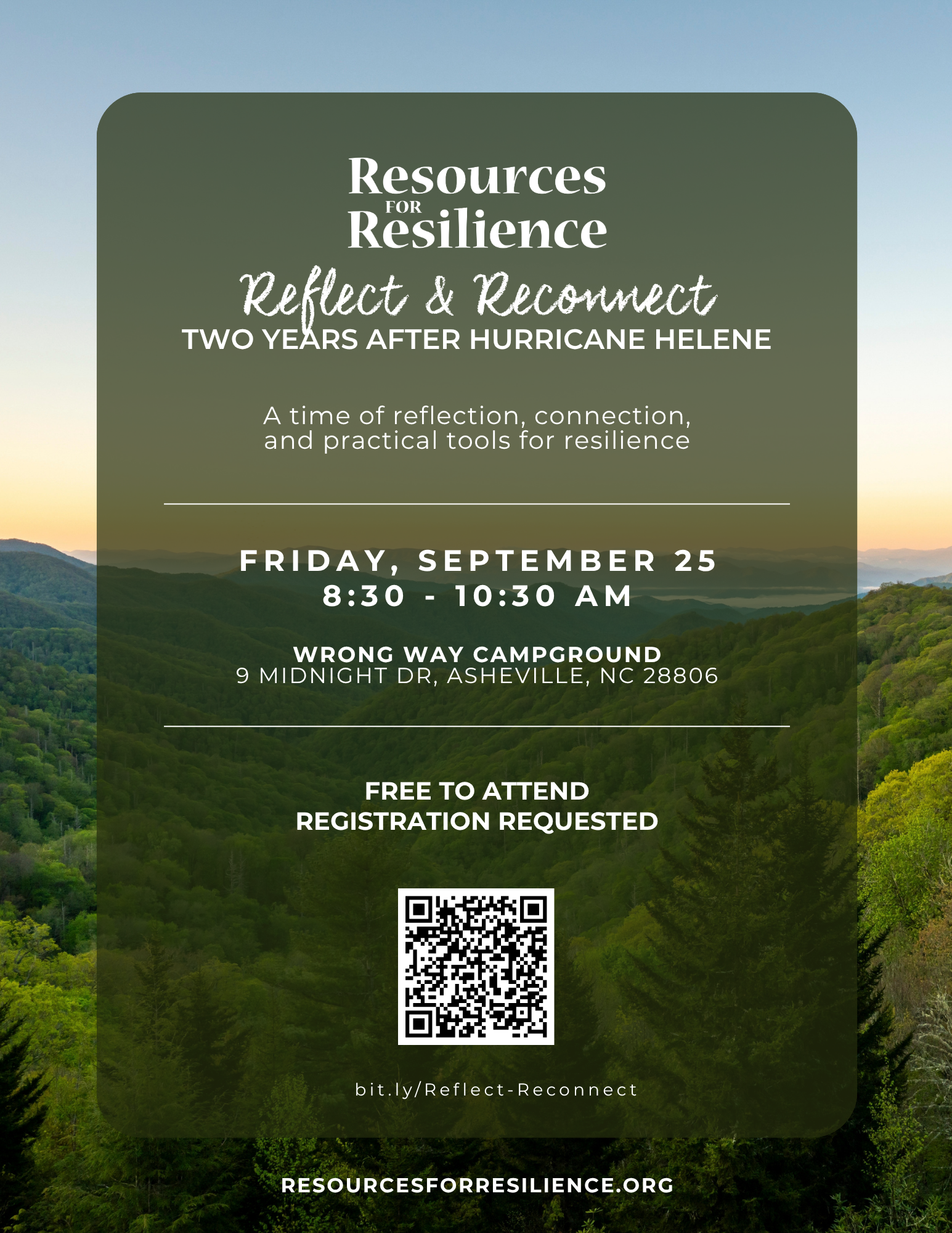
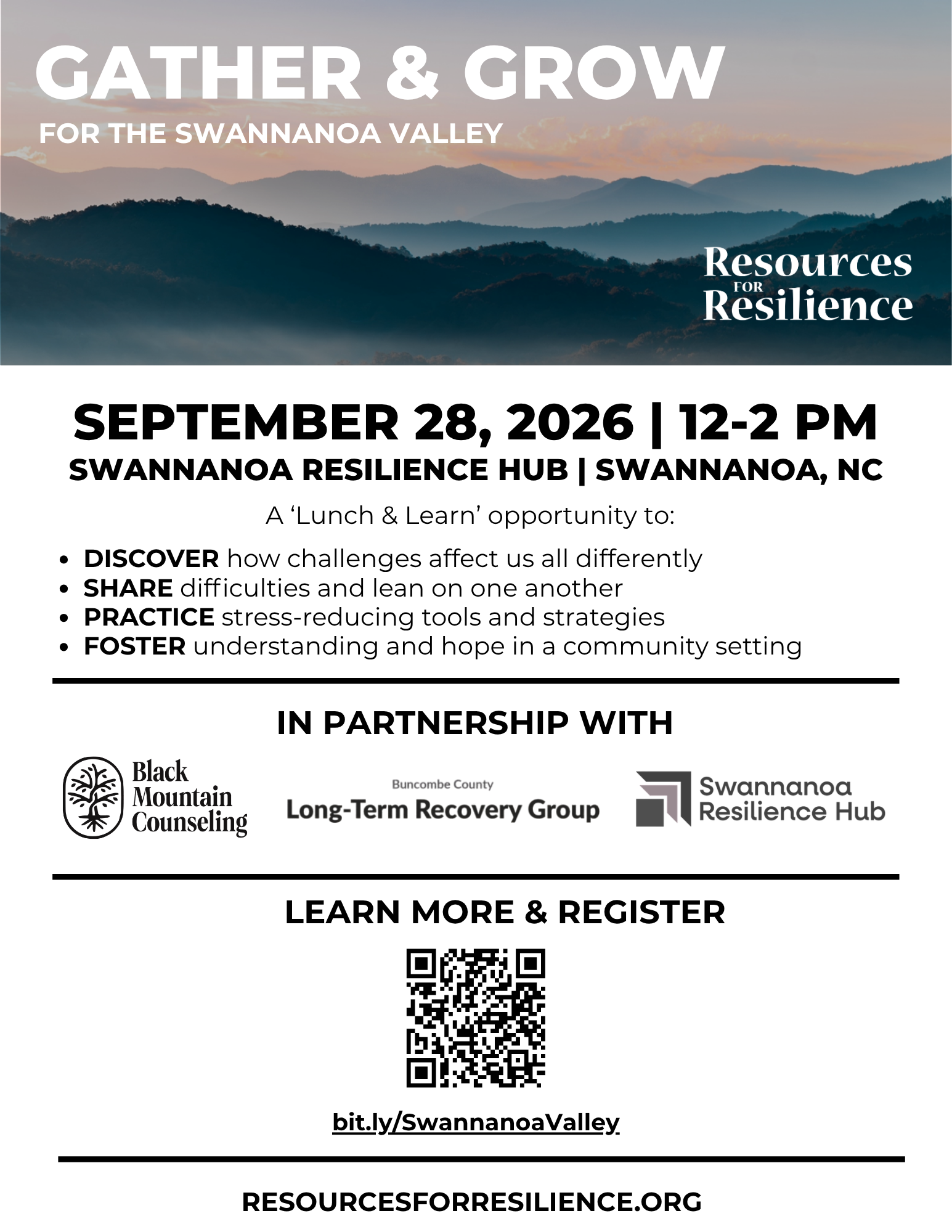
Now through June 2026, Resources For Resilience is offering FREE events and practical tools to help individuals and communities build emotional strength and cope with stress after Helene and other weather-related trauma.

These no-cost workshops and trainings are available throughout the region and are designed to help you understand how your body and mind respond to stress and how to support yourself and others through recovery.

Will you join us?


Related posts

No Results Found

The page you requested could not be found. Try refining your search, or use the navigation above to locate the post.

Scared, But Not Alone: Helping Kids Feel Safe & Connected During Extreme Weather Events

Scared, But Not Alone: Helping Kids Feel Safe & Connected During Extreme Weather Events

Parents and caregivers play a powerful role in shaping how children experience stressful or unpredictable weather events like hurricanes, flooding, wildfires, or other natural disasters.

When adults stay grounded and regulated, kids naturally take their cues from that steadiness. Even in moments of uncertainty, simple, consistent tools can help families feel more connected and secure.


Mental Health Practices for Parents & Children

The programming of Resources For Resilience teaches several practices that parents can use with children when storms stir up fear, memories, or anxiety. Practicing these tools regularly — not just during storms — helps build resilience over time. Kids learn that even when the weather is unpredictable, they have ways to feel safe, supported, and confident navigating whatever comes next.

Use Rapid Resets Together

Gentle tapping, humming, or taking a sip of water can help settle the nervous system. When kids see a calm adult using a Rapid Reset, the tool becomes even more effective. Kids need small moments of relief — play, laughter, and breaks from the heaviness help their bodies and minds recover.

Help Them Sense In

Curiosity goes a long way. This pulls their attention out of fear and back into the present, where their body can begin to settle. In particular, we want them to notice what feels good, comfortable, or even just neutral. Our nervous systems are already masterful at noticing sensations of discomfort or pain for survival reasons, but we want to help them shift the focus to the positive.

Recall A Comforting Memory

Invite kids to think about a favorite place, person, or moment. Remembered safety helps the brain shift out of a stress state and back toward calm.

Look For The Helpers

Pointing out neighbors, responders, or community members who are helping interrupts the brain’s threat response. Noticing safety and support in the environment helps the body relax.

Stay Connected

A calm voice, a cuddle, reading together, or a quick check-in can regulate a child’s nervous system faster than anything else. Connection is one of the most powerful antidotes to fear.

Normalize Their Feelings

Let kids know their reactions make sense. Reassurance helps them feel understood and supported. Phrases like these can help:

    • “I understand why you are afraid. I’m here with you.”
    • “Yes, this is scary. Helene was scary, too — and do you remember how we got through it? We’re even stronger now.”
    • “Everyone feels scared sometimes, and that’s okay. Our bodies are doing their job.”
    • “We’re paying attention. We’re ready to handle whatever comes our way.”
    • “Thankfully our nervous systems are keeping us safe.”

Process Together

Parents can’t prevent every hard moment for their children, but they can help kids by staying present with them and asking them simple questions about what they feel or need. Being open and honest in an age-appropriate way matters more than trying to shield them. They’re going to see and hear things, and what helps most is talking afterward and making sense of it together.

Practice Self-Compassion

Just like our children, most parents are learning as they go, and that’s completely okay. If we’ve never even been through something before, of course we won’t know how to do it perfectly. Every family will move through hard times differently, so giving grace and patience is important.

Wrapping It Up

Extreme weather can shake a family’s sense of safety, but no one has to navigate it alone. Resources For Resilience™ offers simple, practical tools that help parents and youth stay grounded and supported through fear, uncertainty, and recovery.

If you’re looking for ways to strengthen your family’s resilience — before, during, or after a storm — we’re here to help.

Explore our family‑focused workshops and our community trainings, and walk away with easy‑to‑use practices designed to restore calm and clarity for people of all ages. Together, we can help your family feel more prepared, more supported, and more confident facing whatever comes next.


RELATED POSTS

No Results Found

The page you requested could not be found. Try refining your search, or use the navigation above to locate the post.

Hitting “Close To Home”: How to Cope With The Emotions of Extreme Weather, Especially If You’ve Lived It Before

Hitting “Close To Home”: How to Cope With The Emotions of Extreme Weather, Especially If You’ve Lived It Before

As survivors of Hurricane Helene will tell you, past trauma has a way of “compressing time.” Extreme weather can stir up more than logistical stress — for many people, it brings back memories of past storms, evacuations, losses, or long recoveries.

When something was overwhelming the first time, reminders can collapse the distance between “then” and “now.” A person may know they’re safe, but their body may still shift into survival mode — faster heart rate, shallow breathing, irritability, trouble sleeping, or a sense of dread.

Even when we’re physically safe, our bodies may react as if danger is already here. That response is normal. It’s human. And it makes sense.

Why Extreme Weather Can Feel So Intense

For anyone who has lived through a natural disaster such as a hurricane, flood, wildfire, earthquake, or prolonged power outage, the body remembers. The amygdala — the brain’s threat detector — is designed to scan for danger and react quickly. When it recognizes familiar cues (emergency alerts, dark skies, increasing winds, long lines at the store), it may shift into survival mode before you even realize it. For Helene survivors in particular, that collective activation can feel like déjà vu.

That doesn’t mean you’re overreacting. It means your nervous system is doing its job.

People with weather-related or natural disaster trauma may face judgement from themselves or others for being “too sensitive,” “paranoid,” or “overpreparing,” but their reactions make sense. The nervous system remembers past events, so similar sensory experiences can trigger old survival responses.

Your brain and body are trying to protect you by staying alert, planning ahead, and controlling whatever it can.  This may look like:

  • stocking up more than what’s needed
  • double‑checking supplies
  • tracking forecasts more closely
  • worrying about details you never noticed before

Those behaviors are natural instincts and survival responses, normal reactions to having been through something traumatic or overwhelming. The good news: you can help your nervous system settle and move out of survival mode and into your Resilient Zone.

Over time, as your sense of safety rebuilds, the intensity of those urges to overprepare usually softens.

The amygdala doesn’t distinguish between past and present; it only recognizes patterns that once signaled danger.


Practices To Regulate the Nervous System

When emergency weather alerts or storm preparations start to activate old memories, there are simple practices that can help your brain and body find stillness and steadiness again.

Reset The Body

When stress rises, the body often needs support before the mind can catch up. Small, sensory-rich actions can interrupt the stress response and help the nervous system rebalance.

Try:

    • Gentle side-to-side tapping
    • Holding or lifting a heavy object
    • Taking a slow sip of water
    • Humming or making a low, steady sound

These actions become even more effective when you pay attention to the details — the weight of the object in your hands, the temperature of the water, the vibration of your voice. As the amygdala calms, the thinking part of your brain comes back “online,” making it easier to communicate, plan, and problem-solve.

Recall a Positive Memory

It may sound simple, but remembering a heartwarming moment of joy, safety, or connection can shift your body out of a stress state. The brain responds to remembered safety almost the same way it responds to real safety.

You can also remember to “look for the helpers.” Chances are that there are people in the community supporting and checking in on each other, and this fact alone can give your brain evidence that safety, trust, hope, and connection still exist and that you’re not facing the situation alone.

When you interrupt a negative thought loop with something warm or grounding — a favorite place, a loved one’s voice, a moment you felt proud — you’re signaling to your system that it’s okay to return to calm. This is especially helpful when the alerts or coverage start to feel overwhelming.

Connect With Others

Humans are wired for connection, and this is one of the most powerful antidotes to stress. Safe connection is one of the most direct ways to soothe the amygdala and help the body settle.

This works with:

    • Friends
    • Family
    • Neighbors
    • Coworkers
    • Pets (yes, animals count — they help regulate us too!)

A quick check-in, shared laugh, a long hug, or supportive conversation can lower stress hormones and remind your nervous system that you’re not alone.

Practice Self-Compassion

Understanding what you can and can’t control is a powerful way to calm weather-related stress because it gives your brain clarity about what’s yours to manage — and what isn’t.

    • Focus on what you can control: taking practical steps, preparing your space, gathering supplies, making evacuation plans, choosing who you’re with, reaching out for support, and using grounding tools. These actions give your nervous system a sense of agency.
    • Name what you can’t control: the storm’s path, other people’s reactions, or the memories your body brings up. Acknowledging these limits reduces self-blame and helps stop the mind from spinning.
    • Be gentle with yourself: Common judgments — like “I should be over this” or “No one else reacts like this” — overlook or minimize what you lived through. Treating yourself with compassion helps your body settle and supports healing over time. This sounds like:
      • “My body is remembering something real.”
      • “This reaction is about my history, not my character.”
      • “It’s okay to feel this way, and I deserve compassion and care.”
      • “I am doing all that I can to prepare.”
      • “I will get through this, heal, and move forward.”
      • “Every storm is different, and I’ve never been through this one before.”

As you do each of these things (reset, recall, connect, care) notice how you feel physically and emotionally. You may feel more relaxed, confident, calm or clear. Really paying attention to those physical sensations helps solidify the practice in place.


Why These Tools Work

All of these practices help regulate the nervous system — the foundation of how we think, feel, and respond to stress. When the body and mind settle together, it becomes easier to make decisions, communicate clearly, and move forward with confidence.

And there’s an even bigger benefit: When practiced consistently over time, these small actions expand our capacity to handle new stress that comes our way. Eventually the brain and body learn to move more quickly out of survival mode and into a steadier, more grounded state. This is the essence of resilience!

Memories from Helene

Survivors of Hurricane Helene here in North Carolina may feel particularly triggered by new threatening weather systems.

Helene wasn’t just an event — it was a full-body sensory experience filled with sights, sounds, smells, and other physical sensations. And any similar experience of today can reactivate all of those stored memories from the past.

We experienced first-hand how quickly conditions can change. That lived experience can make new forecasts feel more uncertain or ominous, even if the current storm is less severe. The nervous system becomes primed to anticipate the worst because it has seen how bad things can get.

There’s also the thought of another long, painful, and exhausting recovery. A new storm may stir up the emotional residue of that entire post-storm period, not just the event itself. Helene wasn’t just the storm — it was the aftermath:

  • displacement
  • property damage
  • financial strain
  • compromised hygiene
  • illness
  • disrupted routines
  • widespread loss
  • long-term rebuilding

Families and communities across Western North Carolina are still healing from Helene over a year later. We are still recovering and rebuilding physically, financially, AND emotionally. So a new storm feels like damage on top of an already-fresh wound.

During ‘Winter Storm Fern’ in January 2026, the RFR team experienced this PTSD-like trauma firsthand. And across the internet and through discussions with eachother, neighbors, friends and family, we realized that we were not the only ones feeling anxious and amped up being reminded of Helene.

Here is what real WNC residents are saying out there:

  • Storm prep in WNC hits different after Helene… We remember.”
  • I’m scared about the ice storm. I have to act like I’m not for my kids so I’m saying it here.”
  • “I just filled up my old Helene water jugs and I want to vomit.”
  • “I know I’ll be fine but still sitting in the parking lot at the grocery store all teary-eyed because I’m tired of doing this prep work alone.”
  • “I have water, food, blankets, flashlights etc but I broke down multiple times today and realize I’m having a PTSD response.”
  • “The trauma coming up is terrifying.”
  • “Planning on doing a last load of laundry and washing my hair tomorrow in case we don’t have water. Those were never on my storm prep before.”
  • “Pulling out my emergency items from Helene and same 😵‍💫”
  • “My soul… is tired.”
  • Helene. The ice storm of 2002. And the blizzard of ’93. I would much rather be needlessly overprepared that caught without.”
  • It was only ~15 months ago. We’re still traumatized and don’t want to feel so stuck and helpless again.”
  • “Yeah, we’re not feelin so hot.”
  • “I really don’t want to hear trees breaking or falling. That was an awful sound.”
  • “The anxiety ebbs and flows. Definitely upticks when I’m out in public and the collective shared PTSD is palpable. But I feel a little bit better knowing that I’m prepping from a place of experience.”
  • “It is definitely triggering something within me! I feel so anxious, like all of the time!””
  • “It comes in waves mixed with denial.”
  • “Storm anxiety is REAL!”
  • “We’re gonna be okay, but we’re also gonna freak out a bit AND be prepared.”
  • “I don’t think I will ever feel adequately prepped. My teenager is so traumatized she keeps asking if we have enough food and candles and water and did I remember fresh batteries for the flashlights. It’s completely altered us.”
  • “I hate it so much. Wide awake by 4 each night.”
  • “I’ve been doing all the prepping and I have no idea what we’re gonna get. My anxiety is so high.”
  • “I’ve got some jitters, but most of my anxiety is secondhand. My husband is prepping like civilization is a limited edition and the recall just dropped. Batteries, water, solemn glances. I’m nervous too, but laughing feels like a survival skill at this point.”
  • “Really tired of the burnout caused by natural disaster prep. Helene, the wildfires, now this, it just feels like another ‘hunker down and hope for the best.'”
  • “I’m just going to bury myself and my cat under ten blankets and hope it passes soon. I’m tired of preparing for disaster.”
  • “I’m too saturated to know the difference anymore.”

You’re Not Alone — And Your Reactions Make Sense

If extreme weather brings up old feelings or physical reactions, there is nothing wrong with you. Your body is remembering. And you can support it with simple, accessible tools that help you reconnect to safety, steadiness, and community.

At Resources for Resilience, we work with individuals, teams, and communities across North Carolina to help people manage stress, prevent burnout, and build resilience in themselves and others. We offer simple, research-based tools and trainings that help the brain and body settle during moments of overwhelm.

If you’re ready to deepen your own resilience or help others strengthen theirs:

RELATED POSTS

No Results Found

The page you requested could not be found. Try refining your search, or use the navigation above to locate the post.

What is Resilience, Anyway?

What is Resilience, Anyway?

Resilience is one of those words society and culture throws around, stitching into corporate mission statements or motivational speeches. Yet despite its popularity, resilience remains deeply misunderstood.

Resilience is layered and incredibly nuanced. Sometimes it can be messy and chaotic. And sometimes it’s more quiet, subtle, or nearly invisible.

Resilience lives in the cracks, in the pauses, and in the moments you didn’t know you’d make it, but did.

Let’s dive in and explore Resilience more.

“The idea of resilience is fundamental to understanding mental health, especially when it comes to struggling through times that test your mettle. A popular idea in positive psychology, resilience remains somewhat elusive, especially given the fact that everyone’s tolerance for stress differs so much.”

Dr. Susan Krauss Whitbourne

How We Think of Resilience

Resilience can be defined in so many ways. Here are some of the multifacted ways our team and participants describe it in their own words:

  • “The phoenix rising from the ashes”
  • “Your invisible armor”
  • “Your capacity to stay with life—even when it’s hard.”
  • “Your ability to bounce back”
  • “Being the lighthouse in the fog”
  • “When you address uncertainty with flexibility”
  • “Being stronger than the storm”
  • “An act of love”
  • “Saying and believing that even though I don’t feel great right now, I know I will recover.”
  • “How much truth can you hold without breaking”
  • “The story of survival”
  • “Staying present”
  • “Metabolizing life’s experiences”
  • “Being a daffodill covered in snow”
  • “Bending without breaking”
  • “Moving forward stronger, wiser, better.”
  • “Being good at continuing”
  • “Falling down and getting up over and over and over again”

Psychologist Ann Masten describes resilience as “ordinary magic.” In other words, it is not a rare quality, but rather a common human function or ability to adapt in the face of adversity.

“Having a purpose protects the brain. A brain with a purpose is more resilient against distraction, dementia, and depression.”

Dr. Phillipe Douyon

What Resilience Really Is

By definition, resilience is the ability to adapt, recover, and continue growing in the face of adversity.

It is our natural adaptation response doing what it’s designed to do: help us survive under strain and stress. Just as an old oak tree endures year after year of seasons and storms, emotionally resilient people can endure repetitive challenges without becoming overwhelmed by negative emotions.

“Resilience is more about being than doing. Resilence helps us stay gronded and settled. It enables us to sustain and protect ourselves- and eachother- over time.”

Resmaa Menakem

What Resilience Is NOT

To truly understand resilience, we have to unlearn the myths and misconceptions that distort it.

  • Myth: Resilient people are immune to pain

    Truth: Breaking down can be part of healing, not a failure

  • Myth: Resilience is an individual trait

    Truth: It is deeply communal—we build it together

  • Myth: If you’re resilient, you don’t need help

    Truth: Asking for help is an act of resilience

  • Myth: Resilience is something you’re born with

    Truth: It’s a learnable, trainable process

Resilience is NOT…

  • A Static State. Instead, resilience includes waves of anxiety, anger, grief, and fear, burnout, breaking down—it’s the ability to recover, repair and move through those many nervous system states without losing yourself.
  • Emotional Suppression. Holding it together, toughing it out, ignoring pain, swallowing emotions, or performing  is a symptom of survival mode. True resilience includes discernment, boundaries, and the courage to leave harmful sitations.
  • A Solo Act. Humans are wired to regulate through connection. Asking for help and support is not weakness; it’s a biological and emotional necessity.
  • A Personality Trait. It is not something you either have or don’t, or are “good at” or not, like a badge of honor.Resilience is a dynamic capacity shaped by a variety of factors- experience, environment, relationships.
  • Toxic Positivity. Forcing gratitude or optimism in the face of pain or struggle can be emotionally invalidating. Real resilience allows truth before hope.
  • Stoicism. Resilient people feel deeply, and show it. They are changed by life and integrate these experiences without losing the capacity for life, love, and connection.
  • An End Point. Resilience is a journey, not a destination. It’s a living process and daily practice – a set of powerful psychological tools that people develop and grow, step by step, year by year, throughout their lives.

Resilience is not about being unbreakable, untouchable or unfallable. It’s about being honest, adaptive, and supported enough to recover and rebuild—again and again.


Resilience isn’t how calm you can stay in the storm. It’s how much you can feel in the storm without becoming it.

The Resilience Paradox

The resilience paradox is the finding that most people recover well after trauma, yet it’s nearly impossible to predict in advance who will be resilient because no single trait reliably explains it.

Many of us were taught to see resilience as the ability to keep going no matter what, and that was something to be proud of. After all, “What doesn’t kill you makes you stronger”. So we keep pushing through situations that drain us, hoping that if we just try harder or become stronger, things will eventually get better.

However, there’s a point where being strong stops helping you and starts hurting you.

This paradox points to the importance of flexible self‑regulation, because no single trait or strategy works across all situations. In other words, that’s why it’s important to practice resilience mindfully. With self-understanding we can develop the awareness to know when to keep going, when to rest, when to change your approach and when to let go.

“Most people are far more resilient than we give them credit for.”

George Bonanno

What Resilience Looks Like

We’ve looked at some powerful definitions of resilience but they still barely scratches the surface of all that it entails.

Perhaps resilience is about the story of humanity. After all, it can look different for everyone:

  • A single parent holding grief and responsibility at the same time

  • A teenager protecting their identity in a hostile environment

  • A community rebuilding after loss

  • A cancer patient finding moments of joy between treatments

However, if resilience is misunderstood, it’s often because we define it by what it looks like from the outside instead of how it’s built on the inside.

Modern psychology now understands emotional resilience as a dynamic system—much like the body’s immune system—that helps people recover after stress.

It is our bodies way of staying mentally healthy through life’s inevitable challenges.

Resilient people don’t go through life avoiding distress or difficult emotions. Instead, have learned to work through it and relate to pain, stress, and struggle differently.

Over time, by consistently turning “wounds into wisdom,” they develop a stronger sense of optimism, flexibility, meaning, purpose, and oftentimes even stronger relationships and connections.

These qualities are skills that can be strengthened with awareness, time, effort and practice! Together they create a level of psychological toughness. And while some people naturally develop stronger resilience completely on their own, others need support and guidance.

The most important thing to remember is that ANYONE of any age or status can improve their capacity for resilience.

There is an Arabic word:  صبر (Sabr). Sabr comes from the root ṣ-b-r, which means to patiently wait, to persevere, to remain steadfast. The essence of Sabr is about enduring with grace and holding your faith steady when life shakes you.

Why Resilience Is So Complex

Our level of resilience is shaped by an ongoing interaction of internal and external forces:

  • Biology: genetics, brain chemistry, stress hormones

  • Psychology: mindset, emotional regulation, coping strategies

  • Relationships: support systems that either buffer or intensify our stress

  • Culture: what a society defines as strength or vulnerability

  • History: how past trauma has been processed, or not

We tend to equate resilience with endurance, but true resilience goes deeper than that. It involves complex layers of self-reflection, self-reconstruction, self-renewal, and even resistance – refusing to participate in harmful or toxic systems.

“Trauma can serve as a catalyst for growth and resilience, enabling individuals to develop new coping skills, deeper relationships, and a greater appreciation for life”.

Steven Southwick

Why Is Having Resilience So Important?

Emotional resilience does more than help us bounce back from hard moments — it strengthens all aspects of our life, health, happiness, and well-being.

  • Mental Health: Resilience acts as a protective buffer, lowering the risk of anxiety, depression, and PTSD. Resilient people experience less distress and recover more quickly from emotional setbacks.
  • Physical Health: Staying regulated during stress supports the body, helping people feel more balanced and recover more easily from challenges.
  • Professional Life: Resilience reduces burnout and boosts productivity. It helps people adapt to change, solve problems creatively, and stay grounded at work.
  • Personal Life: Emotionally resilient people communicate more effectively, resolve conflict more smoothly, and build stronger, healthier relationships.
  • Spiritual Meaning: Resilience deepens our larger sense of purpose. By working through difficult experiences, people often gain greater compassion, perspective, and appreciation for life. This can be through connection to personal values, to their faith, to their sense of purpose, or calling for service.

This is why we do what we do! This work matters for ourselves, our loved ones, and our future generations.

“The human capacity for burden is like bamboo — far more flexible than you’d ever believe at first glance.”

Jodi Picoult

Wrapping It Up

Resilience isn’t something we’re born with — it’s something we build together, one day, one skill, one connection, and one steady step at a time. We do this through meaningful experiences and seeing our struggle as something larger than the moment.

As Western North Carolina continues navigating our long‑term recovery from Helene, the tools we teach and the information we share is more important now than ever. Our communities need this foundation of learning and support so that we can thrive for years to come.

At Resources For Resilience, we’re committed to making this information accessible to everyone, and YOU are an important part of that mission.

If you’re ready to deepen your own resilience or help strengthen it across our region…

Together, we can keep growing the kind of resilience that carries our communities forward for generations.

“Do not judge me by my success, judge me by how many times I fell down and got back up again.

Nelson Mandela

Resilience Is Rising, Data Shows

Resilience Is Rising, Data Shows

As communities across Western North Carolina continue navigating the long arc of recovery from Helene, a recent Forbes article offers a surprisingly hopeful snapshot of our collective emotional landscape.

Yes, Americans are stressed, overwhelmed, and facing real barriers—but the data also shows something powerful: we haven’t lost our sense of agency, connection, or hope.

At Resources for Resilience, these scientific findings resonate deeply with what we see every day in our trainings and community partnerships. Even in the midst of struggle and strain, people are still reaching for tools that help them regulate, reconnect, and rebuild.

The honesty about hardship and the hope in possibility is at the heart of resilience work, and it’s exactly what the WNC region continues to embody every day.

Stress By The Numbers


Negative Experiences

  • 85% see significant barriers ahead
  • 52% feel burned out.
  • 39% of adults experience a lot of worry.
  • 37% feel so overwhelmed they struggle to do their job
  • 37% experience significant stress
  • 32% of people report physical pain tied to stress
  • 26% of respondents report feelings of sadness related to stress
  • 22% of people report feelings of anger tied to stress

      Positive Experiences

      • 88% feel treated with respect
      • 77% laugh daily
      • 73% experience enjoyment
      • 72% feel well‑rested
      • 52% learned something interesting the previous day

      Hope & Optimism

      • 84% believe they can still create a good life, even if it looks different from previous generations
      • 73% believe they can shape the future for the better
      • 26% doubt they can achieve their dreams

      When describing America today, there is more positive sentiment than negative:

      • 41% said “freedom”, 37% said “opportunity”, 35% said “hope”
      • 38% said “corruption”, 36% said “division”, 32% said “fear”

      SOURCES


      Resources For Resilience

      The Forbes data reinforces what we know to be true: resilience isn’t about avoiding stress—it’s about having the tools and support to move through it.

      People thrive when…

      • they feel a sense of connection, support, and belonging from family, friends, coworkers, neighbors, and community
      • they have relationships that help them reflect, name or regulate emotions, and talk through challenges.
      • they believe the have the agency and responsibility to shape a better future for themselves.

      These are the very skills and practices we teach at Resources For Resilience, and as we can see from the data they’re more essential now than ever.

      As we continue supporting communities across WNC, we’re encouraged to see national research echo what our neighbors demonstrate every day: even in challenging times, hope is alive, and resilience is something we can build together.

      Want to join us in our mission? Visit our Event Calendar to register for an upcoming training or workshop. We also invite you to Subscribe to our mailing list to stay in-the-know on all of our exciting events and happenings.